The decision that determines whether your business model is lean or bloated isn’t made in a lease negotiation or a COVID policy memo—it’s made in the thousands of micro-transactions that never hit your P&L. While line-item budgets capture rent and cleaning contracts, they miss the 7% of income remote workers divert to larger apartments, the $11,000 per employee in hidden employer savings that evaporates when you mandate return-to-office, and the productivity tax extracted by open-plan distractions. Research from post-pandemic workforce analysis reveals that 71% of American workers now prefer remote arrangements, yet fewer than 23% of small businesses have adjusted their financial models to capture the true cost delta.
This accounting gap creates a dangerous paradox: the easiest overhead reduction strategy delivers the highest ROI, yet receives the least rigorous financial analysis. While you obsess over vendor contracts and software subscriptions, your office lease—the fixed cost that determines your break-even altitude—operates on autopilot, often preserving a model that made sense in 2019 but bleeds cash in 2026. Understanding the full cost architecture of location decisions transforms you from a passive rent-payer into an active architect of your cost structure.
- The Invisible Architecture: Where True Costs Hide
- The Cost Diffusion Hierarchy: What Actually Shows Up on Budgets
- The Psychology of Place: Why We Misprice Location Value
- The Visibility Premium: We Overvalue What We Can See
- The Control Illusion: Why Managers Fear Remote Work
- The Education Gap: Financial Illiteracy About Distributed Costs
- The Multiplier Effect: How Small Location Decisions Cascade
- The Tipping Point of Scale
- The Cost Cascade in Action
- Real-World Impact: Three Businesses, Three Location Strategies
- The SaaS Startup That Chose Remote and Hired 3 More Engineers
- The Law Firm That Signed a Prestige Lease and Lost Two Associates
- The Marketing Agency That Hybridized Into the Worst of Both Worlds
- The Compound Cost Trap: Why Hybrid Often Fails
- The Decision Matrix: Choosing Your Location Strategy
- Stage-Based Decision Rules
- Industry-Based Heuristics
- Your Location Strategy Is Either a Competitive Weapon or a Financial Anchor
The Invisible Architecture: Where True Costs Hide
Every aspect of your location strategy rests on a foundation of costs that accounting systems were never designed to capture. The electricity bill for your office is a clear expense; the 40% increase in a remote employee’s home energy use is a personal burden that indirectly affects retention. The cleaning contract for your suite is negotiated; the mental health impact of isolation on remote workers is unbilled until it appears in turnover statistics.
Consider something as mundane as the square footage per employee. A traditional Manhattan Class A office at $93.65 per square foot with 150 square feet per worker costs $14,047 annually in rent alone. That same employee working remotely might trigger a need for a home office—a spare bedroom that costs them an extra $400/month in rent, which translates to a $4,800 annual compensation pressure they’ll eventually bring to you. The office cost is visible and fixed; the remote cost is diffuse and eventually becomes your problem through salary negotiations or attrition.
Commercial utilities average $2.10 per square foot annually. For a 5,000-square-foot office, that’s $10,500 yearly. But remote workers upgrade internet plans ($50-100/month), increase heating/cooling usage (40% of home energy bills), and purchase ergonomic lighting and equipment. These costs, while individually small, collectively represent a 6.5% to 9.8% increase in housing expenditure according to National Bureau of Economic Research data. You’re not eliminating utility costs; you’re externalizing them onto your workforce.
The Cost Diffusion Hierarchy: What Actually Shows Up on Budgets
Office-Visible Costs: Lease payments, commercial internet, janitorial contracts, property insurance
Remote-Externalized Costs: Home internet upgrades, increased utility bills, ergonomic equipment, larger housing
Hybrid-Hidden Costs: Underutilized office space, duplicate equipment, coordination friction, meeting inefficiencies
Psychological Ledger Costs: Commute time value, isolation impact, collaboration friction, retention pressure
The Psychology of Place: Why We Misprice Location Value
If remote work is so cost-advantageous, why do 54% of managers report wanting employees back in offices? The answer lies in a combination of status quo bias, control psychology, and accounting blind spots that train our decisions toward visibility over viability.
The Visibility Premium: We Overvalue What We Can See
A bustling office with your logo on the door feels like success. It’s concrete, photographable, and validates the entrepreneurial dream. The $3,000 lease check feels like an investment in that vision. Meanwhile, the $11,000 per employee you save with remote work (per Global Workplace Analytics) is invisible—diffused across reduced turnover, lower absenteeism, and eliminated relocation costs. You can’t photograph “saved $11,000,” so your brain discounts it as less real.
This prestige bias is reinforced by commercial real estate norms. A Manhattan address signals legitimacy to clients and investors. A remote-first company with employees in 47 zip codes feels amorphous. The algorithm in our minds rewards physical presence, even when the financial ledger rewards virtual distribution.
The Control Illusion: Why Managers Fear Remote Work
Supervision feels easier when you can see employees. The unspoken fear is that remote workers will slack off without observation. Yet data from CU Independent’s analysis shows 77% of remote workers report higher productivity at home, and 35-40% quantifiable productivity increases are common. The control you feel in an office is psychological; the productivity you gain remotely is empirical.
This bias serves as a gatekeeping mechanism. Managers who built careers on presenteeism resist models that devalue their oversight skills. The result is a management philosophy that works well for command-and-control but alienates autonomous knowledge workers who drive modern revenue.
The Education Gap: Financial Illiteracy About Distributed Costs
Small business financial training focuses on visible P&L items—rent, payroll, COGS. It rarely addresses cost externalization or employee-borne expenses. This curriculum gap isn’t accidental; it’s easier to teach line-item budgeting than systems thinking.
The consequence is generations of business owners who can manage a profit margin but have no framework for calculating total cost of employment by location. They know their lease payment to the penny but can’t estimate the salary premium their remote team requires to offset home office costs. This knowledge gap creates a decision vacuum that commercial landlords happily fill.
The Multiplier Effect: How Small Location Decisions Cascade
Location decisions don’t exist in isolation—they cascade through your entire cost structure, creating outcomes far larger than their origins. This multiplier effect explains why a $500/month office decision can generate a $50,000 annual impact.
Consider a 10-person startup choosing between a 1,500-square-foot Brooklyn office at $51.94/sq ft ($77,910/year) and a remote-first model. The direct savings seem clear: $77,910 preserved. But the cascade begins: that savings funds an additional developer’s salary, accelerating product development by 3 months. Faster launch means earlier revenue. Earlier revenue means better Series A valuation. The location decision didn’t just save rent—it shifted your entire growth trajectory.
The reverse cascade is more common. A design agency signs a 3-year lease in Manhattan’s Class B space at $61.66/sq ft for 3,000 square feet ($184,980/year). To justify the fixed cost, they must hire locally at NYC salary premiums ($85,000 for a $65,000 role elsewhere). The salary increase consumes the “prestige” value of the address. Cash flow tightens, forcing them to take on client work outside their specialty, diluting brand positioning. The office lease, meant to signal success, becomes the anchor that prevents it.
The Tipping Point of Scale
The cost advantage of remote work compounds non-linearly with headcount. A 5-person team saves $55,000 annually by going remote. A 50-person team saves $550,000. But a 150-person company doesn’t save $1.65 million— it saves $2.3 million because at that scale, office requirements shift from coworking memberships to custom buildouts, and the inefficiencies of coordinating hybrid schedules create their own management layer.
The Cost Cascade in Action
Initial Decision: Choose remote-first over 2,000 sq ft office at $45/sq ft
Direct Result: $90,000 annual rent savings
Secondary Effect: Redirect savings to hire 1.2 additional employees, accelerating roadmap
Tertiary Effect: Faster product launch captures market share before competitor entry
Quaternary Effect: Market position strength leads to 3x valuation multiple in next funding round
Real-World Impact: Three Businesses, Three Location Strategies
The abstract becomes concrete through case studies. These examples demonstrate how location decisions created cascading financial outcomes for businesses of different sizes and stages.
The SaaS Startup That Chose Remote and Hired 3 More Engineers
A 12-person SaaS startup in Denver was spending $8,400/month on a 2,400-square-foot office ($35/sq ft). When the lease expired, they calculated total loaded costs: $100,800 annually in rent plus $18,000 in utilities, cleaning, and insurance—$118,800 total. By going fully remote and providing each employee a $200/month home office stipend ($28,800/year), they saved $90,000. They redirected $75,000 to hire an additional senior engineer and a customer success manager. The engineering velocity increase allowed them to ship a critical integration 4 months earlier, which directly resulted in closing a $250,000 enterprise deal that wouldn’t have been possible without those headcount additions. The “cost saving” became a revenue driver.
The Law Firm That Signed a Prestige Lease and Lost Two Associates
A 7-lawyer firm signed a 5-year lease on 3,000 square feet of Class A space in downtown Boston at $58/sq ft—$174,000 annually. They justified it as necessary for client trust and recruiting. Within 18 months, two junior associates quit, citing the mandatory 5-day/week policy and the fact that their commutes consumed 2.5 hours daily. Replacement recruitment cost $47,000 in recruiter fees and lost revenue during the 4-month gaps. Meanwhile, overhead pressure forced them to increase billable hour requirements, reducing pro bono work that had been their talent pipeline. The “prestige” address cost them $221,000 in year one, not including the salary premium they paid to hire locally at Boston market rates. A hybrid model would have allowed them to recruit from Providence or Worcester at a 30% salary discount.
The Marketing Agency That Hybridized Into the Worst of Both Worlds
A 25-person creative agency attempted a hybrid model with a 4,000-square-foot office designed for 15 hot-desk users at $42/sq ft ($168,000/year). They required Tuesday-Thursday in-office attendance. The result: they paid for space that sat 60% empty on mandated days due to client travel and sick days. They spent $22,000 on desk booking software and management overhead. Employees reported feeling “homeless”—neither fully remote nor office-based—leading to the lowest morale scores in company history. Their Glassdoor rating dropped from 4.3 to 3.1, increasing recruitment costs by 40%. The hybrid compromise satisfied no one while doubling their real estate cost per actually-present employee to $11,200/year—higher than a full office would have been.
The Compound Cost Trap: Why Hybrid Often Fails
The hybrid model promises the best of both worlds but often delivers the worst of both cost structures. It requires paying office rent while simultaneously subsidizing remote work. The math looks logical—half the time in office means half the space needed—but human behavior breaks the model.
Flexible spaces offer an alternative, but at a price. Traditional office leases in 2021 cost $8-23/sq ft monthly, rising to $38.96/sq ft in Q1 2023. Flexible memberships seem cheaper until you calculate per-person, per-day costs. A $400/month hot desk used 12 days averages $33/day—more expensive than a $25 day pass if your usage is irregular.
The hidden cost of hybrid is coordination. Scheduling who comes when, managing overlapping client meetings, and ensuring teams overlap requires administrative overhead that doesn’t exist in pure office or pure remote models. This friction tax often exceeds 5-7% of productive hours—costs that never appear on a lease but drain profitability.
The Decision Matrix: Choosing Your Location Strategy
There’s no universal right answer, only the right answer for your specific business model, stage, and talent strategy. Use this framework to quantify the decision rather than defaulting to tradition.
Stage-Based Decision Rules
Pre-Seed/Solopreneur: Home office + meeting room rentals. Keep overhead near zero. Your runway is more valuable than your address.
Seed Stage (2-10 employees): Remote-first with home office stipends ($100-200/month). Invest savings in product and talent, not walls.
Growth Stage (11-50 employees): Evaluate based on talent needs. If hiring locally, consider coworking flex passes. If distributed, remain remote-first with annual team offsite budget.
Scale Stage (50+ employees): Hybrid only if you can commit to 60%+ in-office utilization. Otherwise, regional hubs with remote distribution capture 80% of collaboration value at 40% of cost.
Industry-Based Heuristics
Knowledge Work (Software, Design, Consulting): Remote-first is default. Office is optional prestige tax.
Client-Facing Professional (Law, Finance, Agency): Location matters for trust. Choose coworking with professional meeting rooms over traditional lease.
Hardware/Physical Product: You need space for inventory and shipping. Consider industrial flex space, not downtown office towers.
Your Location Strategy Is Either a Competitive Weapon or a Financial Anchor
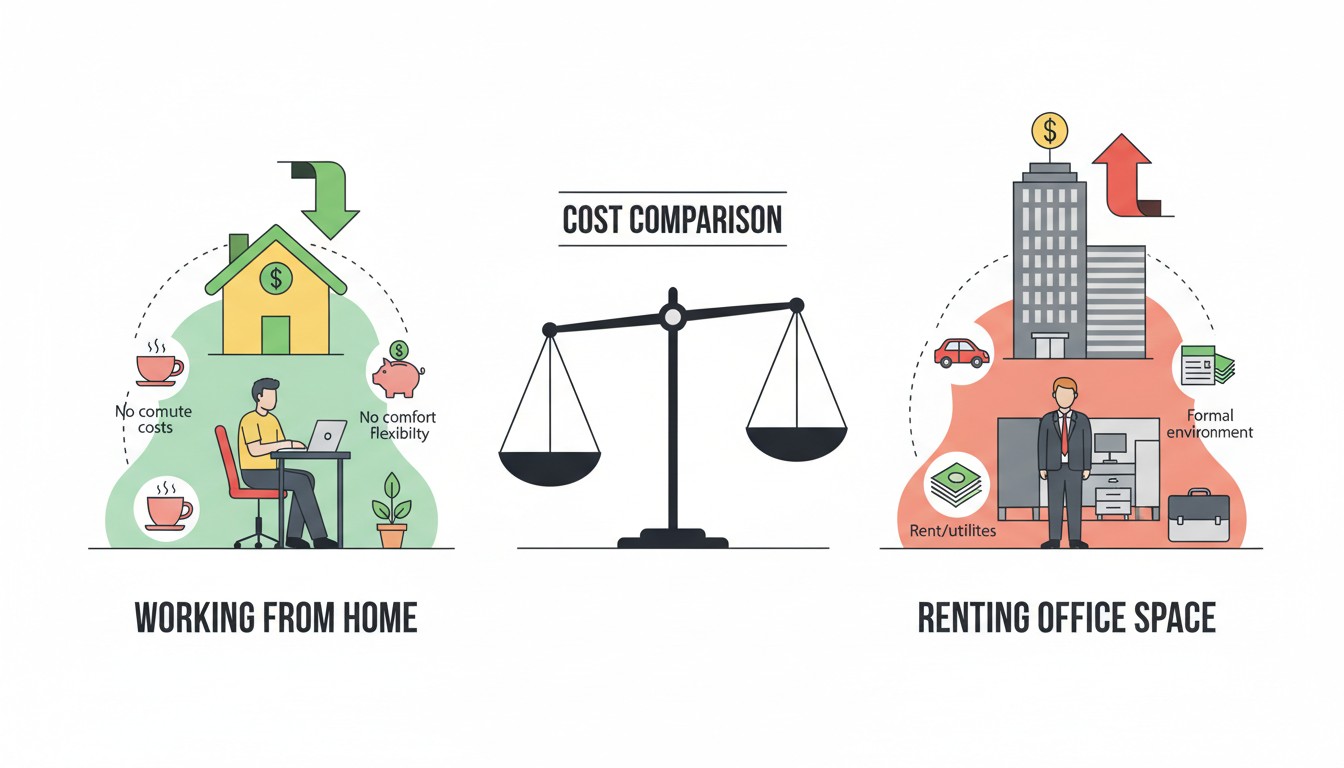
The cost comparison between working from home and renting office space isn’t a spreadsheet exercise—it’s a strategic decision about what kind of business you’re building. The office lease you’re considering isn’t just a rent payment; it’s a commitment to a fixed cost that will shape every hiring decision, every product roadmap, every fundraising conversation for the next 3-5 years.
The remote work you’re resisting isn’t just a lifestyle preference; it’s a financial structure that transforms $90,000 in rent into two additional engineers, or a six-month extension of your runway, or the ability to hire talent from a market where salaries are 30% lower. The hybrid compromise you’re considering isn’t the best of both worlds—it’s often the most expensive way to satisfy the control needs of managers while incurring the coordination costs that neither pure model requires.
The choice is yours. Run the numbers honestly, including the invisible costs your accounting system ignores. Test your assumptions about productivity and culture. Recognize that in 2026, the majority of your workforce has already voted with their feet for flexibility. You can be the business that captures the $11,000 per employee annual advantage, or you can be the business that pays it as tribute to a commercial landlord for space your team uses three days a week. One decision builds a moat. The other digs a hole.