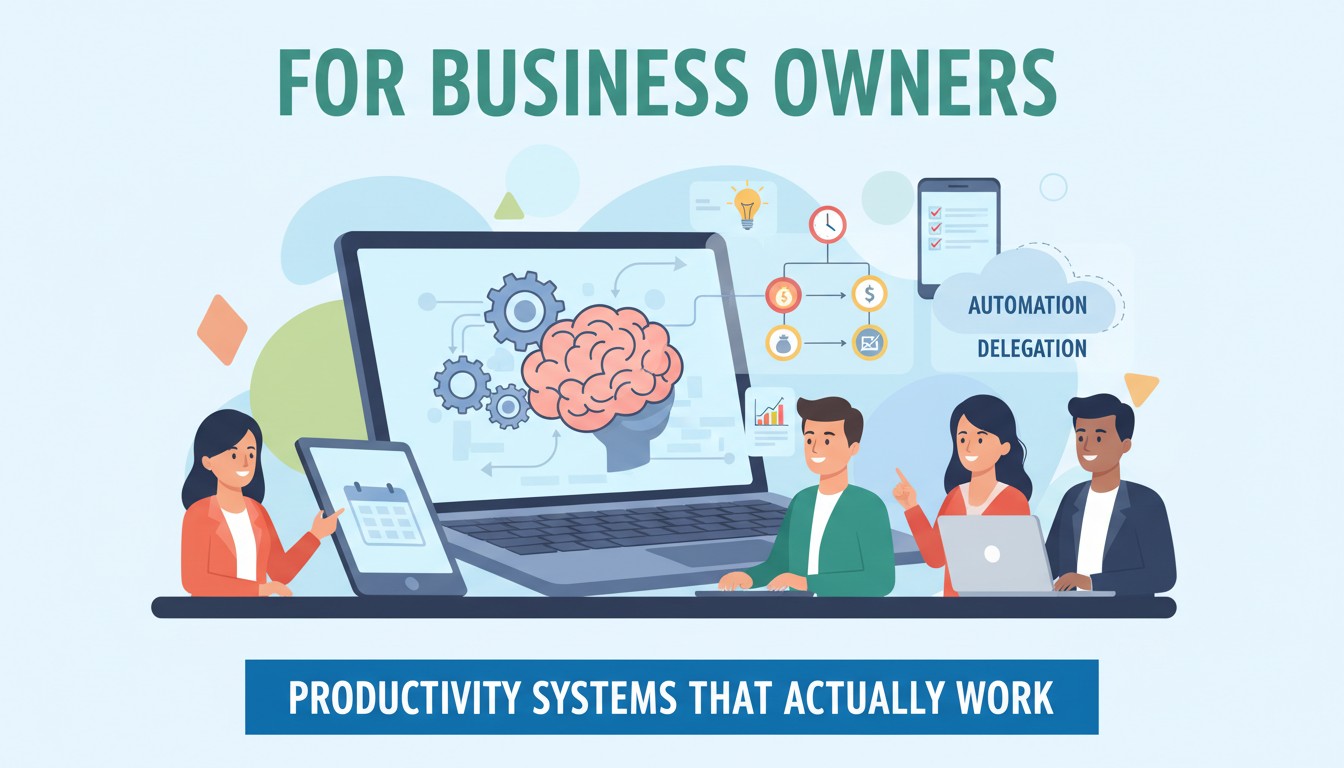
The decision that determines whether your business operates like a well-oiled machine or a digital junkyard isn’t made when you choose your project management software—it’s made in the thousands of micro-decisions about whether your tools serve your workflow or become a second job themselves. Productivity systems in 2026 don’t reward feature richness; they reward implementation consistency. Yet research from productivity studies shows 90% of entrepreneurs say managing tasks and workflows is their biggest challenge, and the average business owner wastes 13 hours weekly on minor tasks like data entry, invoicing, and ordering supplies—costing $33,800 annually in lost productivity at a $100K salary.
This optimization paradox creates a dangerous trap: the more tools you adopt, the less productive you become. While you obsess over finding the “perfect” system and configuring every automation, you’re ignoring the fundamental truth: tools are only 30% of productivity—the other 70% is the system you build around them. Understanding how to implement productivity systems that serve your business model transforms you from a tool collector into a time architect.
- The Invisible Architecture: How Tools Become Distractions
- The Productivity Trust Hierarchy: What Actually Drives Execution
- The Psychology of Tool Addiction: Why We Collect Instead of Execute
- The Shiny Object Syndrome: New Tools Feel Like Progress
- The Completionist Bias: Unfinished Setups Feel Like Failure
- The Ego Validation: Complex Systems Signal Sophistication
- Real-World Impact: Systems That Transformed Businesses
- The Agency Owner Who Dropped Asana for Paper and Doubled Revenue
- The Consultant Who Automated One Thing and Reclaimed 12 Hours/Week
- The CEO Who Went from 80-Hour Weeks to 20 Hours with One Habit
- The Multiplier Effect: How Simple Systems Compound
- The Consistency-Confidence Loop
- The System Cascade in Action
- Practical Playbook: Your 90-Day Productivity System Transformation
- Weeks 1-2: The Audit & Foundation
- Weeks 3-6: The Habit Build
- Weeks 7-12: The Optimization & Scale
- Your Productivity System Is Either a Growth Engine or a Time Sink
The Invisible Architecture: How Tools Become Distractions
Every aspect of your productivity rests on a foundation of attention allocation. The speed of your task completion, the consistency of your follow-through, the health of your focus—these aren’t determined by how many apps you have, but by how well your system protects your deep work. Productivity experts call this “tool coherence,” but it’s more accurately a focus preservation system that determines whether your energy flows toward execution or evaporates into configuration.
Consider something as mundane as your task manager. A business owner who spends 3 hours setting up Asana with 47 projects, nested tags, and color-coded priorities feels productive. But if they don’t have a daily habit of checking it for 10 minutes each morning, they continue operating from memory and email, and the tool becomes digital clutter. Another owner uses a simple paper list with three priorities, reviews it daily without fail, and ships critical projects on time. The sophisticated tool created overhead; the simple system created results.
Workflow automation creates similar invisible impacts. A consultant sets up a 12-step Zapier automation that connects their contact form to CRM to email sequence to calendar. When one API breaks, they spend 4 hours debugging instead of calling the prospect directly. The automation that was supposed to save time became a technical debt that cost them a $15,000 deal. According to workflow research, entrepreneurs who implement automation without first mastering the manual process waste 23% more time on tool maintenance than they save on task execution.
The Productivity Trust Hierarchy: What Actually Drives Execution
Critical Systems: Daily priority review, weekly planning ritual, protected deep work blocks
Secondary Systems: Task capture (anywhere), time tracking, automation of repetitive tasks
Tertiary Systems: Project templates, meeting protocols, notification management
Toxic Systems: Complex automations, multi-app workflows, feature-rich tools without habits
The Psychology of Tool Addiction: Why We Collect Instead of Execute
If simple systems are so effective, why do business owners consistently default to complex tool stacks that create more overhead than value? The answer lies in a combination of shiny object syndrome, completionist bias, and misaligned incentives that train our behavior toward collecting over completing.
The Shiny Object Syndrome: New Tools Feel Like Progress
Downloading a new productivity app triggers a dopamine hit that feels like you’ve accomplished something. The setup process—choosing themes, creating projects, inviting team members—mimics real work but produces no real outcomes. After years of testing productivity tools, I’ve identified that only 5% actually deliver meaningful results, yet entrepreneurs spend an average of 13 hours weekly on tool-related activities rather than revenue-generating tasks.
This syndrome is reinforced by tool marketing that promises transformation. “Transform your workflow!” “10x your productivity!” The promise feels tangible, but the habit formation required to achieve it is left unsaid. You buy the tool but don’t build the routine, so the tool sits dormant while you continue operating from your inbox.
The Completionist Bias: Unfinished Setups Feel Like Failure
Once you start configuring a tool, your brain treats an incomplete setup as unfinished business. You spend 4 hours creating the perfect Asana project structure but never actually using it for daily work. The 80% complete system nags at you, creating cognitive load that reduces your actual output.
The completionist drive, which serves us well in finishing client projects, becomes toxic when applied to tool configuration. You don’t need a perfect system—you need a used system. A minimally configured tool that you touch daily will always outperform a perfectly configured tool you check weekly.
The Ego Validation: Complex Systems Signal Sophistication
Showing a client your 47-project Asana board with color-coded priorities and automated workflows feels professional. A simple notebook with three daily priorities feels amateurish. This ego-driven complexity creates systems that look impressive but are too cumbersome to maintain.
The truth is inverse. A business owner who delivers every project on time using a simple paper system demonstrates mastery. The complexity of your tools is inversely proportional to the clarity of your focus. Simple systems are robust systems. Complicated systems break.
Real-World Impact: Systems That Transformed Businesses
These case studies demonstrate how implementing simple, consistent productivity systems achieved outsized impact by focusing on execution over optimization.
The Agency Owner Who Dropped Asana for Paper and Doubled Revenue
A 12-person creative agency spent $3,600/year on Asana, with a full-time ops person managing it. Projects were still late. The owner spent 5 hours/week updating tasks. They scrapped it all and implemented a simple system: Monday morning 30-minute standup where each person writes their top 3 priorities on a whiteboard. No digital tracking. Daily 10-minute check-ins. Within 60 days, project delivery improved 40% because people stopped managing software and started managing work. The ops person was repurposed to client management, generating an additional $25K monthly revenue. The “primitive” system worked because it was used, not because it was perfect.
The Consultant Who Automated One Thing and Reclaimed 12 Hours/Week
A solo consultant was manually scheduling discovery calls, sending calendar invites, follow-up emails, and intake forms. He spent 12 hours/week on admin. Instead of buying a complex CRM, he implemented one Zapier automation: when a Calendly appointment was booked, it automatically added the contact to his email list, sent a confirmation email, and delivered the intake form. Setup time: 90 minutes. Cost: $50/month. Time saved: 12 hours/week, which he redirected to billable client work, adding $60K annual revenue. The key wasn’t the tool—it was automating the one task that created the biggest bottleneck before adding any other features.
The CEO Who Went from 80-Hour Weeks to 20 Hours with One Habit
After a health scare, a CEO had to reduce his hours from 80 to 20 while maintaining business growth. He tried every productivity tool but continued drowning. The breakthrough wasn’t a tool—it was one habit: “Winning the Week” planning every Friday afternoon for 90 minutes. He reviewed the previous week, identified the three priorities for the upcoming week that would move revenue, and scheduled them as non-negotiable blocks. Everything else got delegated or deleted. He used a simple notebook. Within 6 months, his business grew 35% and his profit margin increased from 18% to 32% because he stopped doing low-value work. The system was just disciplined planning; the tool was irrelevant.
The Multiplier Effect: How Simple Systems Compound
Productivity systems don’t operate in isolation—they create compound advantages that accelerate your entire business. This multiplier effect explains why a 30-minute daily habit can outperform 10 hours of heroic effort.
Consider the “daily 3 priorities” habit. Initially, it seems minor—just writing down what’s important. But the cascade begins: you stop getting distracted by low-value tasks, so your deep work quality improves. Better work product leads to happier clients, who refer more business. Because you’re focused, you spot opportunities to productize your service, creating passive income. The cumulative effect of daily prioritization transforms you from reactive freelancer to strategic business owner.
The reverse cascade is more common. No system means you’re always reacting to the loudest fire. Every day starts with email, which trains clients to expect instant responses. You work evenings and weekends to catch up, burning out and delivering subpar work. Subpar work creates more client complaints, creating more fires. Small habit gap, systemic business breakdown.
The Consistency-Confidence Loop
Simple systems work because they build consistency, which builds confidence. A business owner who plans their week every Friday without fail creates predictability. That predictability reduces anxiety and decision fatigue. The reduced stress improves sleep and focus, making them more effective during work hours. The effectiveness reinforces the habit. This loop becomes a competitive moat that competitors can’t cross without abandoning their own chaos.
The System Cascade in Action
Initial Habit: Write 3 daily priorities every morning (5 minutes)
Direct Result: Stop getting distracted, deep work quality improves 40%
Secondary Effect: Better work → happier clients → 40% more referrals
Tertiary Effect: Mental bandwidth spots productization opportunity, creates passive income
Quaternary Effect: Transforms from freelancer to business owner with 60% profit margin
Practical Playbook: Your 90-Day Productivity System Transformation
Understanding productivity systems is useless without execution. Here’s a concrete plan to move from tool chaos to strategic execution.
Weeks 1-2: The Audit & Foundation
1. **Audit your current tools:** List every productivity app, subscription, and system. Calculate total monthly cost and weekly time spent managing them
2. **Identify your #1 bottleneck:** Where do projects stall? Is it task prioritization, communication, or follow-through?
3. **Choose ONE foundation tool:** Pick either task management (Asana/Todoist) or calendar blocking (Google Calendar). Delete everything else
4. **Implement the 3-priority rule:** Each day, write down only 3 tasks that must get done. Everything else is optional
5. **Schedule a “Winning the Week” ritual:** Friday afternoon, 90 minutes, non-negotiable for planning the next week
Weeks 3-6: The Habit Build
1. **Use your foundation tool daily:** No matter how imperfectly, touch it every single day for 10 minutes
2. **Automate ONE repetitive task:** Pick your most time-consuming admin task and create one simple automation (Zapier or native tool)
3. **Protect deep work blocks:** Schedule 2-hour blocks Monday-Thursday where you turn off all notifications
4. **Track your time:** Use a simple tool like Toggl or a notebook to see where your hours actually go
5. **Review weekly:** Did you complete your 3 priorities most days? If not, why? Adjust the system, not just the tasks
Weeks 7-12: The Optimization & Scale
1. **Measure your results:** Has your billable hours increased? Stress decreased? Projects delivered on time more often?
2. **Add ONE complementary tool:** If your foundation is solid, add ONE tool for your biggest remaining pain point
3. **Document your system:** Write a 1-page playbook so new team members can adopt it instantly
4. **Teach your team:** If you have employees, train them on the system. Shared language amplifies impact
5. **Quarterly review:** Every 90 days, audit your system. Is it still serving you or have you outgrown it?
Your Productivity System Is Either a Growth Engine or a Time Sink
The productivity system you’re chasing isn’t found in a new app subscription or a complex automation workflow. It’s found in the boring consistency of writing down three priorities every morning. It’s found in the discipline of planning your week every Friday afternoon. It’s found in the courage to delete tools that look impressive but create overhead.
Your power to build a productive business doesn’t require finding the perfect tool stack. It requires building the habit stack that turns any tool into a lever for execution. The entrepreneur who ships work with a paper list will always outperform the entrepreneur who configures dashboards they never check.
Start today. Pick one foundation tool. Delete the rest. Commit to using it daily for 90 days. Your productivity transformation begins with a single decision to stop collecting and start completing.