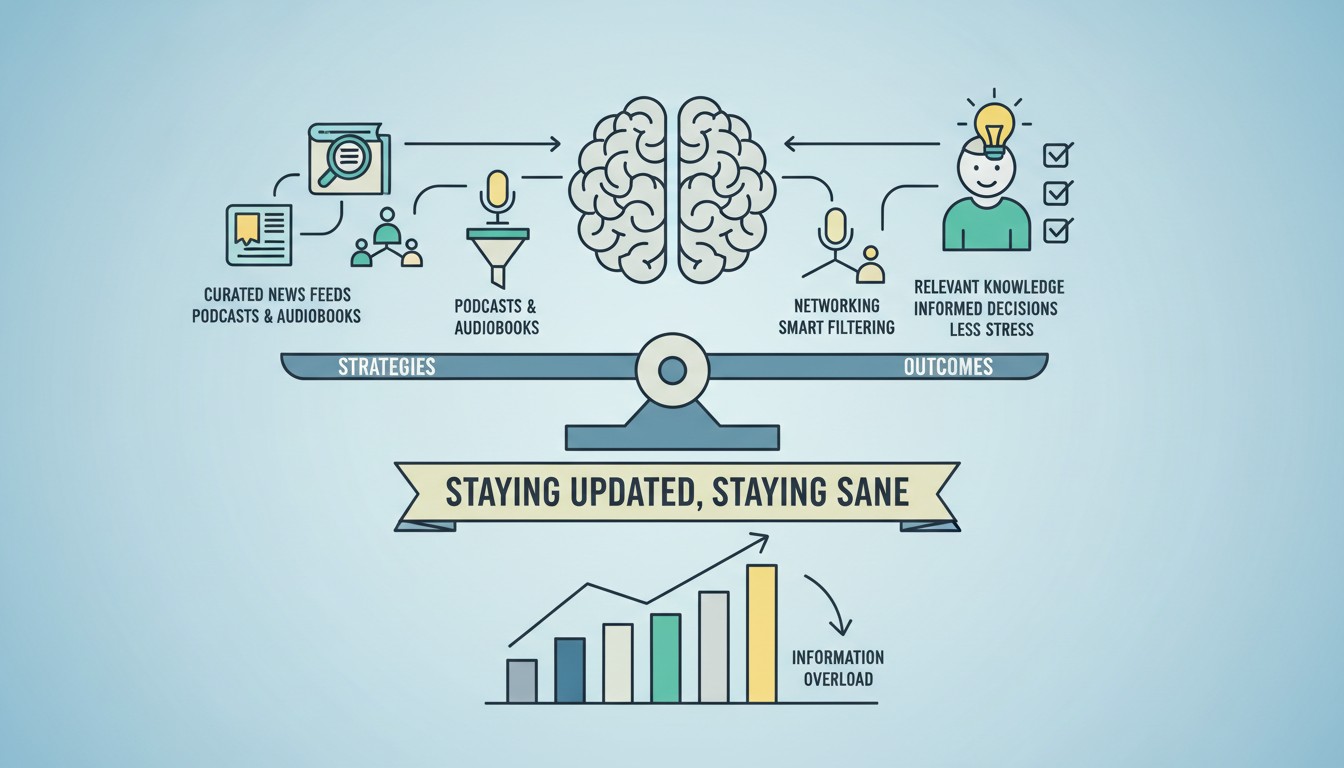
The decision that determines whether you’re an industry authority or an overwhelmed aggregator isn’t made when you subscribe to another newsletter—it’s made in the thousands of micro-decisions about what to open, what to ignore, and what to act on. Industry awareness in 2026 doesn’t reward consumption volume; it rewards signal detection and strategic application. Yet research from digital overload studies shows knowledge workers spend 88% of their workweek communicating and consuming information, leaving almost no time for focused execution, while 60% report burnout directly linked to information overload.
This consumption paradox creates a dangerous trap: the more you try to stay current, the more you fall behind. While you obsess over being “in the know,” your actual competitive differentiator—your ability to execute on insights—atrophies. Understanding how to monitor your industry strategically transforms you from a passive information victim into an active opportunity hunter.
- The Invisible Architecture: How Information Overload Destroys Your Edge
- The Attention Value Hierarchy: What Actually Drives Competitive Advantage
- The Psychology of Digital Hoarding: Why We Subscribe to Everything and Read Nothing
- The FOMO Tax: We Pay with Attention
- The Status Signal: Being “In the Know” Feels Like Competence
- The Completionist Bias: Unread Feels Like Undone
- Real-World Impact: Professionals Who Fixed Their Information Diet
- The Marketing Director Who Unsubscribed From Everything and Tripled Her Impact
- The Consultant Who Built a “Competitive Intelligence” System Out of RSS Feeds
- The Developer Who Outsourced Industry Monitoring to AI and Focused on Execution
- The Multiplier Effect: How Small Filtering Choices Compound
- The Confidence-Action Loop
- The Filtering Cascade in Action
- Practical Playbook: Your 90-Day Information Diet Transformation
- Weeks 1-2: The Audit & Brutal Unsubscribe
- Weeks 3-6: The System Build
- Weeks 7-12: The Optimization & Scale
- Your Industry Awareness Is Either a Strategic Asset or a Mental Liability
The Invisible Architecture: How Information Overload Destroys Your Edge
Every aspect of your professional relevance rests on a foundation of attention allocation. The depth of your analysis, the speed of your strategic pivots, the quality of your decision-making—these aren’t determined by how much you consume, but by how well you filter. Industry experts call this “strategic awareness,” but it’s more accurately a signal-to-noise ratio that separates insight from distraction.
Consider something as mundane as your LinkedIn feed. The algorithm serves you 50+ posts daily from your network, but only 2-3 contain genuinely actionable intelligence. A professional with a systematic filter (e.g., “I only read posts from CXOs at Series B+ companies in my niche”) identifies a market shift three months before the mainstream. Their competitor who mindlessly scrolls everything “stays current” but misses the pattern entirely because it’s buried in noise. That three-month head start affects their product roadmap, their sales positioning, and their fundraising narrative—yet the decision process happens in a 10-second scroll versus a 10-minute strategic review.
Newsletter subscriptions create similar invisible impacts. A consultant subscribes to 23 industry newsletters, feeling “informed” when each arrives. But they never read 78% of them, creating digital clutter that buries the 3-4 critical updates that would have triggered a client conversation. According to information overload research, 38% of employees feel overwhelmed by communication volume, and workers experience interruptions every 3-11 minutes, taking 23 minutes to regain focus. Each unread newsletter is a cognitive tax, not a knowledge asset.
The Attention Value Hierarchy: What Actually Drives Competitive Advantage
Critical Signals: Direct competitor moves, regulatory changes, client buying pattern shifts, emerging technology threats
Secondary Signals: Market sizing data, pricing trends, talent movement, VC investment patterns
Tertiary Signals: Thought leadership opinions, conference recaps, generic best practices, motivational content
Toxic Noise: Daily news cycles, social media hot takes, “industry trends” lists with no data, FOMO-driven content
The Psychology of Digital Hoarding: Why We Subscribe to Everything and Read Nothing
If strategic filtering is so effective, why do professionals consistently default to maximal consumption? The answer lies in a combination of FOMO psychology, ego gratification, and misaligned incentives that train our behavior toward hoarding over discerning.
The FOMO Tax: We Pay with Attention
Every newsletter unsubscribe feels like a potential missed opportunity. What if that one issue contains the insight that changes your business? This fear drives subscription behavior that would be irrational in any other domain. You wouldn’t buy 47 magazines and never read them, but you’ll subscribe to 47 newsletters and let them pile up digitally.
Research from Wedia Group shows that 55% of employees waste excessive time figuring out how to reply or interpret written messages, and 30% have noticed communication with clients and coworkers has gotten significantly tougher over the past year. The FOMO that drives us to hoard information actually reduces our ability to communicate effectively about what matters.
The Status Signal: Being “In the Know” Feels Like Competence
Dropping a reference to the latest industry report in a client meeting feels like expertise. Sharing a “fascinating article” in Slack signals you’re engaged. These micro-performances create an ego payout that reinforces consumption behavior, even when the actual business impact is zero.
The irony is that true expertise comes from depth, not breadth. A professional who has deeply analyzed three white papers and applied their insights to client work creates more value than someone who skimmed 50 articles but changed nothing about their approach. Yet our culture rewards the appearance of being informed over the discipline of being strategic.
The Completionist Bias: Unread Feels Like Undone
That “unread” counter on your email app or RSS reader triggers a psychological need to clear it. It feels like unfinished work. This completionist drive, which serves us well in task management, becomes toxic when applied to information consumption. You don’t need to “finish” the internet, but your brain treats each unread item as an open loop.
This bias is weaponized by content platforms. LinkedIn shows you “3 new posts” to create a variable reward loop. Substack shows unopened issues. Twitter’s infinite scroll never gives you a finishing point. The design is engineered to exploit your completionist psychology, keeping you consuming rather than executing.
Real-World Impact: Professionals Who Fixed Their Information Diet
These case studies demonstrate how strategic information filtering transformed competitive positioning and reduced burnout for knowledge workers across different industries.
The Marketing Director Who Unsubscribed From Everything and Tripled Her Impact
A SaaS marketing director subscribed to 34 industry newsletters, followed 200+ influencers on LinkedIn, and listened to 5 marketing podcasts weekly. She spent 12 hours/week consuming content but implemented only 1-2 ideas monthly. Her team called her “the idea tornado”—full of new concepts but lacking follow-through. She implemented a radical filter: canceled all newsletters, unfollowed everyone except 7 proven CMOs, and limited podcasts to one weekly deep-dive. She replaced consumption with a “trend analysis Friday” where she reviewed one white paper and wrote a 1-page implementation memo. Within 90 days, her team executed 12 high-impact initiatives (up from 8 in the previous year), and her CEO praised her “strategic clarity.” She reclaimed 9 hours/week and reported a 70% reduction in work-related anxiety.
The Consultant Who Built a “Competitive Intelligence” System Out of RSS Feeds
A management consultant spent $600/month on industry reports and 15 hours/week reading them, yet consistently missed competitor moves until clients mentioned them. He built a minimalist system: 5 RSS feeds (competitor blogs, SEC filings, industry journal), Google Alerts for 10 specific keywords, and a 30-minute daily review block. He created a shared “Intel Summary” doc where he wrote one paragraph daily on “one thing that matters.” This doc became his client conversation starter and newsletter source. Within 6 months, he predicted two major market shifts that his competitors missed, winning both clients who needed proactive strategy. His “information budget” dropped to 5 hours/week and $0, while his perceived expertise skyrocketed.
The Developer Who Outsourced Industry Monitoring to AI and Focused on Execution
A senior developer spent 8+ hours/week on Hacker News, Reddit programming forums, and tech newsletters to “stay current.” His actual coding output dropped 40%, and he missed a promotion because his project delivery was late. He implemented a “monitoring stack”: an AI summary tool (Roam Research) that condensed 20 sources into daily bullet points, a Friday afternoon 1-hour deep dive into one technical paper, and a rule: no industry reading Monday-Thursday. His coding output returned to peak levels, and he shipped a critical feature that earned him a $25K bonus. He realized his value wasn’t knowing everything—it was building things with what he knew.
The Multiplier Effect: How Small Filtering Choices Compound
Strategic information filtering doesn’t operate in isolation—it creates compound advantages that accelerate your career trajectory. This multiplier effect explains why a 30-minute weekly review can outperform 10 hours of scattered consumption.
Consider choosing three “signal sources” instead of 30. Initially, it feels like you’re missing out. But the cascade begins: you actually read every issue from your three sources, extracting actionable insights weekly. You implement one idea monthly. Your clients notice you’re “always ahead of the curve.” Referrals increase. Your proposals reference recent industry shifts, showing you’re current and strategic. Win rates improve. The confidence from winning allows you to raise rates. One filtering decision, exponential career growth.
The reverse cascade is more common. Subscribing to 30 sources creates decision paralysis. You don’t read any deeply, so you implement nothing. Your knowledge is a mile wide and an inch deep. Clients can’t distinguish you from competitors who also “stay current.” You compete on price, not insight. Small consumption decision, systemic commoditization.
The Confidence-Action Loop
Strategic filtering builds confidence because you actually process and use what you consume. That confidence triggers action—trying the new approach, pitching the innovative solution, writing the thought leadership piece. Action produces results, which reinforces the value of your filtering system. You trust yourself to spot what matters, so you ignore the rest. This loop becomes a competitive moat that competitors can’t cross without abandoning their own overload habits.
The Filtering Cascade in Action
Initial Choice: Choose 3 signal sources instead of 30
Direct Result: Actually read everything, extract 1 actionable insight monthly
Secondary Effect: Clients notice strategic thinking, referrals increase 40%
Tertiary Effect: Proposals reference recent shifts, win rates improve 25%
Quaternary Effect: Confidence allows 30% rate increase, becomes industry thought leader
Practical Playbook: Your 90-Day Information Diet Transformation
Understanding filtering strategy is useless without execution. Here’s a concrete plan to move from overwhelmed to strategically informed.
Weeks 1-2: The Audit & Brutal Unsubscribe
1. **Audit all subscriptions:** List every newsletter, podcast, RSS feed, and social media follow. Count them.
2. **Apply the “3-source rule”:** Keep only 3 primary sources that directly impact revenue. Unsubscribe/delete everything else.
3. **Track your consumption time:** Use a tool like RescueTime to measure actual hours spent on “industry updating”
4. **Define your signal criteria:** What makes information actionable? (e.g., “client buying patterns shift,” “new regulation announced”)
5. **Set up Google Alerts:** For 5-10 specific keywords (competitor names, regulatory terms, technology threats) to catch what matters automatically
Weeks 3-6: The System Build
1. **Create a “trend analysis Friday”:** One dedicated hour weekly to review your 3 sources and write a 1-page implementation memo
2. **Use AI summarization:** Tools like Roam Research or Notion AI can condense long articles into bullet points for faster scanning
3. **Build a “signal” document:** A running doc where you log one insight weekly that changed your thinking or approach
4. **No-consumption mornings:** Block 9 AM-12 PM daily for deep work—no industry reading allowed
5. **Share insights strategically:** Turn your weekly memo into client-facing content (newsletter, LinkedIn post) to demonstrate expertise
Weeks 7-12: The Optimization & Scale
1. **Measure your signal-to-noise ratio:** How many insights did you act on vs. total items consumed? Aim for 10%+
2. **Review your 3 sources:** Are they delivering actionable signals? If not, replace one with a better-fit source
3. **Build your “competitive moat”:** Use insights to change one thing: your pitch, your service offering, your pricing model
4. **Track the business impact:** Did your rate increase stick? Did new positioning win clients? Did thought leadership drive leads?
5. **Teach your system:** Document your filtering process. Teaching it cements it as your permanent operating rhythm
Your Industry Awareness Is Either a Strategic Asset or a Mental Liability
The information diet you’re resisting isn’t a limitation—it’s liberation. Every competitor who seems “more connected” isn’t smarter or more dedicated. They’re simply more overwhelmed, spending 88% of their week consuming while you spend 50% executing. The algorithm rewards consistency, not consumption. The client rewards insight, not awareness.
Your power to stay truly current doesn’t require reading everything. It requires reading the right things and—most importantly—acting on them. The industry is shifting whether you’re watching or not. The competitor is making moves whether you’re monitoring them or not. You can be the professional who catches the signal and builds the response, or the professional who catches everything and builds nothing.
Start today. Unsubscribe from 10 sources. Pick your 3. Schedule your Friday deep-dive. Your edge transformation begins with a single decision to stop drowning and start swimming.