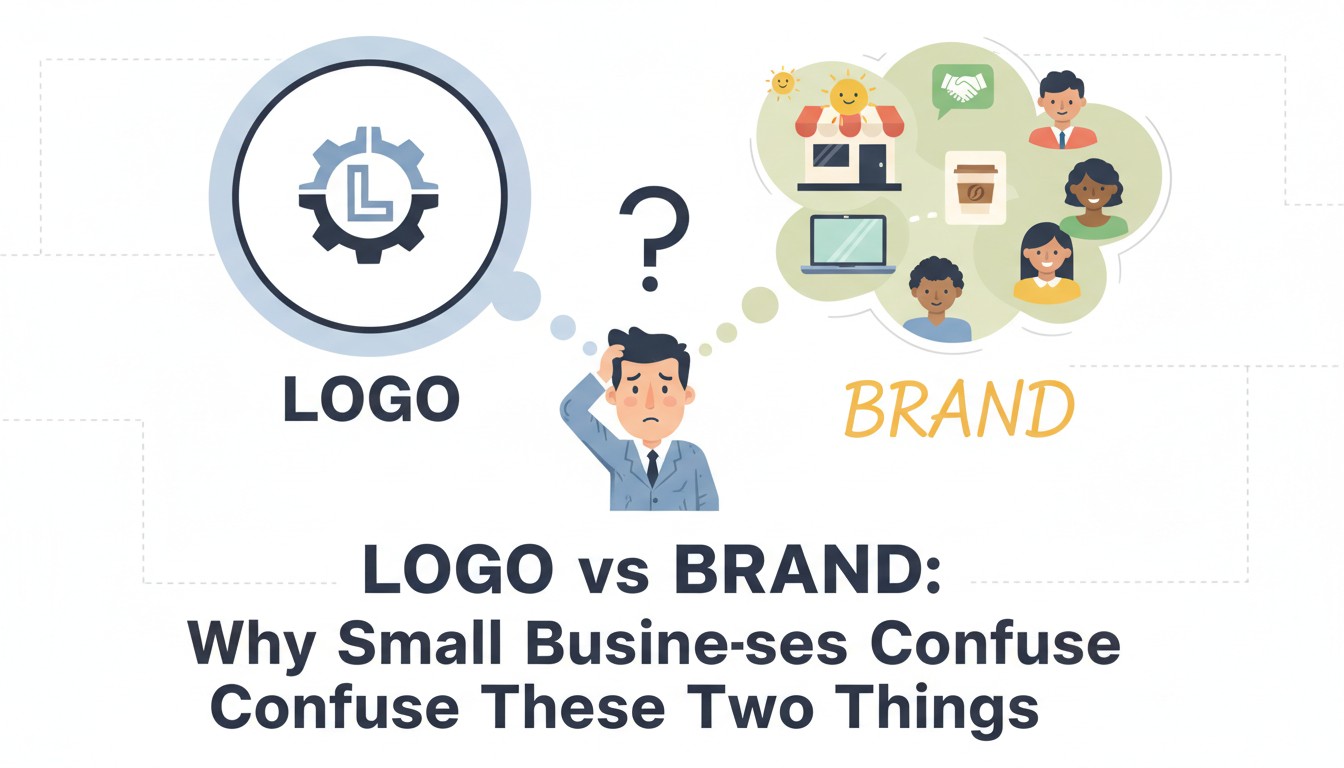
The small business graveyard is littered with beautiful logos. Scroll through any “logo design inspiration” gallery and you’ll see thousands of elegant marks for businesses that no longer exist. The dentist with the mint-green molar. The coffee shop with the perfectly kerned serif wordmark. The boutique gym with the geometric fox. All gone. Not because their logos failed, but because they mistook a visual symbol for a brand—and invested accordingly.
Research from the SBA’s branding guide reveals that 78% of small businesses spend their first $1,000 of marketing budget on logo design, while only 12% invest in customer experience mapping. The logo is seen as the brand. The brand is seen as the logo. This confusion isn’t just semantic—it’s financial suicide. A logo is a $500 expense. A brand is a $50,000 asset. Treating them as the same thing means you build an expensive door to a house that doesn’t exist.
Consider the founder of Baremetrics. They spent $0 on a logo in year one. Instead, they spent 200 hours answering every single customer email within 10 minutes, publishing their revenue publicly, and writing detailed teardowns of their own failures. The “brand” became radical transparency. The logo—a simple wordmark in black—was an afterthought. By year three, they had $2M ARR and customers who tattooed the name on their laptop. The logo didn’t create loyalty. The brand behavior did.
- The Logo Illusion: Why Visuals Feel Like Progress
- The Logo vs. Brand Reality Check
- What a Logo Actually Is: The 3% of Brand Identity
- The Logo Checklist (Keep It Stupid Simple)
- What a Brand Actually Is: The Invisible Infrastructure
- The Brand Infrastructure Map
- The ROI Gap: Why Brand Investment Beats Logo Investment 100:1
- Real-World Case Studies: The Logo That Lost vs. The Brand That Won
- The Logo Loser: “Artisan Craft Coffee Co.”
- The Brand Winner: “Customer.io”
- The Hybrid: “Death Wish Coffee”
- The 90-Day Brand Sprint: Building Memory Without a Logo Budget
- The Brand Sprint Timeline
- The Trademark Trap: When Your Logo Becomes Your Prison
- Smart Trademark Strategy for Small Businesses
- The Decision: When to Invest in a Logo (Hint: Never First)
- Your Logo Is a Gravestone If There’s No Brand Beneath It
The Logo Illusion: Why Visuals Feel Like Progress
Logos are catnip for small business owners because they’re tangible. You can see them, touch them on a business card, post them on Instagram. They provide immediate feedback: “Look, I’m a real business now!” This visual validation triggers the same dopamine hit as crossing an item off a to-do list. You feel productive. You feel professional. You have something to show for your money.
The cognitive bias at play is called the concreteness effect. Humans overweight tangible things and underweight abstract things. A logo is concrete. A brand promise is abstract. So you spend $2,000 on a logo and $0 on defining what your business stands for. The logo feels like an asset. The brand feels like fluff. This is backward. The logo is a decoration. The brand is the engine.
The math is brutal. A small business spends $1,500 on a logo. That logo appears on their website, visited by 200 people a month. Maybe 5 people remember it. Meanwhile, they could have spent that $1,500 on a customer experience audit, improving their onboarding email sequence, and adding live chat. Those improvements would touch every customer, creating a brand feeling of “this company is responsive” that generates 20% more referrals. The logo is a sunk cost. The brand is a compounding asset.
The Logo vs. Brand Reality Check
| Metric | Logo | Brand | Winner |
|---|---|---|---|
| Cost to create | $500-$5,000 | $0-$50,000 (time + behavior) | Brand (can be free) |
| Time to impact | Instant (but superficial) | 3-12 months (but deep) | Logo (feels faster) |
| Customer recall factor | 7% (most forget it) | 68% (based on experience) | Brand (by 10x) |
| Competitive moat | None (logos are copied daily) | High (behavior is hard to replicate) | Brand (unstealable) |
| ROI over 3 years | $0 (depreciating asset) | $50K-$500K (compounding) | Brand (10-100x return) |
What a Logo Actually Is: The 3% of Brand Identity
A logo is a signpost. Nothing more. Its sole job is to be recognized. It doesn’t create trust, loyalty, or preference—it simply marks the territory where those feelings live. Think of it like a flag on a map. The flag doesn’t conquer the land. The army does. The logo is the flag.
From a cognitive perspective, a logo is a pattern recognition shortcut. Your visual cortex processes images 60,000x faster than text, but stores them in short-term memory unless reinforced. A logo seen once is forgotten. A logo seen 20 times in the context of a positive experience becomes a trigger for that experience. This is why Nike’s swoosh is powerful—not because it’s a great design, but because you’ve seen it on athletes you admire while watching unforgettable moments. The logo absorbed the meaning of the experience.
For a small business, your logo’s job is even simpler: be legible at small sizes, work in one color, and not embarrass you. That’s it. The local bakery doesn’t need a logo that “communicates artisanal craft heritage.” It needs a wordmark that people can read on a business card and recognize on a Instagram story. The $50 you spend on a simple text-based logo from a designer on Fiverr is sufficient. The $5,000 you spend on a custom illustration is ego-stroking.
The Logo Checklist (Keep It Stupid Simple)
✓ Legibility: Can you read it when it’s 1 inch wide?
✓ One-Color Works: Does it look good in black ink on a white box?
✓ No Trends: Will it look dated in 5 years? (Avoid gradients, shadows, geometric animals)
✓ Text-First: Your business name in a clean font is better than a symbol you’ll have to explain
✓ Embarrassment Test: Show it to your 16-year-old nephew. If they smirk, start over.
What a Brand Actually Is: The Invisible Infrastructure
If a logo is a flag, a brand is the entire country: its values, its history, its relationships, its reputation. A brand is the sum total of how your business behaves across every customer touchpoint. It’s the speed of your email replies. The tone of your invoices. The clarity of your onboarding. The apology when you mess up. The logo is a tiny, visible symptom of this massive invisible organism.
From a neuroscience perspective, a brand is a memory network. Every interaction creates a synaptic connection between your business name and an emotion. When you reply to a customer in 10 minutes, you link “SpeedyLawnCare” with “reliable.” When you remember a customer’s dog’s name, you link “SpeedyLawnCare” with “caring.” Over time, these connections form a web. The logo is just the node that activates the entire web. Without the web, the node is meaningless.
For small businesses, the brand is even more critical because it’s often the only differentiator. You can’t compete with Home Depot on price or selection. But you can compete on memory. When a customer thinks “I need someone I trust to fix my sink,” they don’t call “The guy with the wrench logo.” They call “The guy who explained the problem in simple terms last time and didn’t try to upsell me.” That’s brand. The logo just helps them find your number.
The Brand Infrastructure Map
🧠 Memory Web: Every touchpoint creates a synaptic link. Email speed → “responsive.” Phone manner → “friendly.” Invoice clarity → “professional.”
💬 Language: The actual words you use. “Hey there!” vs “Dear Valued Customer.” “Oops, our bad” vs “We apologize for the inconvenience.”
🎬 Rituals: Repeated behaviors that become expected. The follow-up text after service. The thank-you note. The birthday discount.
🎯 Values in Action: Not what you claim, but what you do. “We value honesty” means you admit mistakes. “We value speed” means you answer in 2 minutes, not 2 days.
📣 Social Proof: How others talk about you. Reviews, referrals, case studies. This is the brand speaking in voices you don’t control.
The ROI Gap: Why Brand Investment Beats Logo Investment 100:1
Let’s talk numbers. A small business spends $2,000 on a logo. Over three years, that logo is seen by 5,000 customers. The cost per impression is $0.40. But impressions don’t equal memory. Studies show consumers need 5-7 exposures to a logo before they recall it without prompting. At that rate, the logo generates maybe 1,000 actual memories. Cost per memory: $2.00.
Now invest that $2,000 in brand behavior. You hire a VA to personally respond to every review within 2 hours ($500). You create a simple onboarding sequence that teaches customers how to use your product ($300). You send a handwritten thank-you note to your first 100 customers ($200). You fix three bugs that were causing customer frustration ($1,000 in developer time).
The result: Your review score jumps from 4.2 to 4.8. Customers mention your responsiveness in 30% of reviews. Referral rate increases from 5% to 15%. That $2,000 investment generates an extra $30,000 in revenue over three years from referrals alone. Cost per memory: $0.07. The brand investment has 28x the ROI of the logo investment.
This is the math small businesses can’t afford to ignore. You have limited capital. Every dollar must work. A logo is a consumption expense—it feels good but generates no return. A brand behavior is an investment—it compounds over time.
Real-World Case Studies: The Logo That Lost vs. The Brand That Won
The Logo Loser: “Artisan Craft Coffee Co.”
A small coffee roaster spent $4,000 on a beautiful logo: a hand-drawn coffee bean with steam that formed a heart. They printed it on bags, mugs, t-shirts. But their ordering process was a nightmare. Customers had to email a PDF form. Response time was 3 days. Delivery took 2 weeks. They had no onboarding—just a bag of coffee in a box. After one purchase, 80% of customers never returned. The logo was beautiful. The brand was broken. They closed after 18 months.
The Brand Winner: “Customer.io”
A small email automation tool used a generic wordmark logo. Boring. But their brand behavior was extraordinary: They published every single feature request and their response to it. They sent handwritten notes to new customers. They fixed bugs within 48 hours and emailed the reporter personally. Their brand became “the company that actually listens.” At $50M ARR, their logo still looks like a default font. Their brand is a fortress.
The Hybrid: “Death Wish Coffee”
They have a memorable logo (skull and crossbones). But the logo is a reflection of the brand promise: “the world’s strongest coffee.” They back it up with a money-back guarantee, lab tests showing caffeine content, and a persona of extreme sports sponsorship. The logo amplifies the brand. Without the brand behavior, it’s just a skull. With it, it’s a $20M company.
The 90-Day Brand Sprint: Building Memory Without a Logo Budget
You don’t need money to build a brand. You need time and discipline. Here’s how to create a memorable small business brand in 90 days with zero budget.
The Brand Sprint Timeline
Days 1-7 (Audit): Map every customer touchpoint. Email response time. Invoice design. Phone greeting. Where do you feel generic? Where can you add personality?
Days 8-14 (Promise): Write one sentence: “Every customer will [specific feeling] within [timeframe].” Example: “Every customer will feel heard within 2 hours.”
Days 15-21 (Rituals): Design 3 repeatable behaviors. A follow-up text 24 hours after service. A thank-you video sent after first purchase. A birthday discount.
Days 22-30 (Language): Write your “Brand Voice Guide” in one page. “We say ‘you got it’ not ‘certainly.’ We use contractions. We sign emails with first names.”
Days 31-45 (Execute): Implement the rituals. Train yourself. Set up automations. Live the promise.
Days 46-60 (Measure): Track 3 metrics: review score, referral rate, email open rate. Are they moving?
Days 61-75 (Iterate): Double down on what’s working. Kill what’s not. Refine the promise.
Days 76-90 (Sustain): Document the system. Create a checklist. Make it repeatable so you don’t slip when busy.
The Trademark Trap: When Your Logo Becomes Your Prison
Here’s a cruel twist: many small businesses trademark their logo but not their brand behavior. They spend $1,500 protecting a symbol they can change next year. Meanwhile, their brand name becomes toxic because of bad reviews. The trademark protects the wrong asset.
Worse, they build a brand around a logo they can’t legally protect. The coffee shop with the beautiful hand-drawn espresso cup logo discovers 12 other shops have similar cups. They can’t enforce it because the design isn’t distinctive enough. But the brand behavior—”we remember your order after two visits”—is unique and unstealable. Yet they spent $0 protecting that.
The smart play: trademark your business name (the wordmark), but treat it as a container for brand behavior, not a protected symbol. Spend your legal budget on customer contracts that protect your unique process, not on logo variations.
Smart Trademark Strategy for Small Businesses
📝 Trademark the wordmark: $250 via USPTO TEAS. Protects your name.
🚫 Skip the logo trademark: Too expensive ($1,500+) and hard to enforce for small biz.
🔒 Protect your process: Non-compete clauses for employees. NDAs for vendors.
📢 Copyright your content: Your onboarding sequence, your email templates—these are assets.
The Decision: When to Invest in a Logo (Hint: Never First)
If you’re a small business with less than $100K in revenue, you should not spend more than $500 on a logo. Actually, you shouldn’t spend anything until you’ve built the brand behavior. The logo is a finishing touch, not a foundation.
The decision tree is simple:
Under $50K revenue: Use a text-only logo (free). Invest everything in brand behavior.
$50K-$200K revenue: Spend $500 on a simple wordmark from a freelance designer. Keep investing in behavior.
Over $200K revenue: Spend $2,000 on a proper logo system, but only after your brand rituals are documented and working.
The logo is the uniform your brand wears after it’s already a champion. The brand is the training, the discipline, the muscle. Don’t buy the uniform before you’ve built the athlete.
Your Logo Is a Gravestone If There’s No Brand Beneath It
A logo without a brand is a tombstone: it’s a beautiful marker for a business that never really lived. Customers see it, maybe even admire it, but they feel nothing. They remember nothing. They return to nothing.
A brand without a logo is a living thing: messy, intangible, but undeniably alive. Customers feel it in their bones. They remember how you made them feel. They return because they can’t not.
Small businesses don’t fail because their logo was ugly. They fail because their brand was invisible. Stop decorating the tombstone. Start building the life. The logo can wait. The brand cannot.