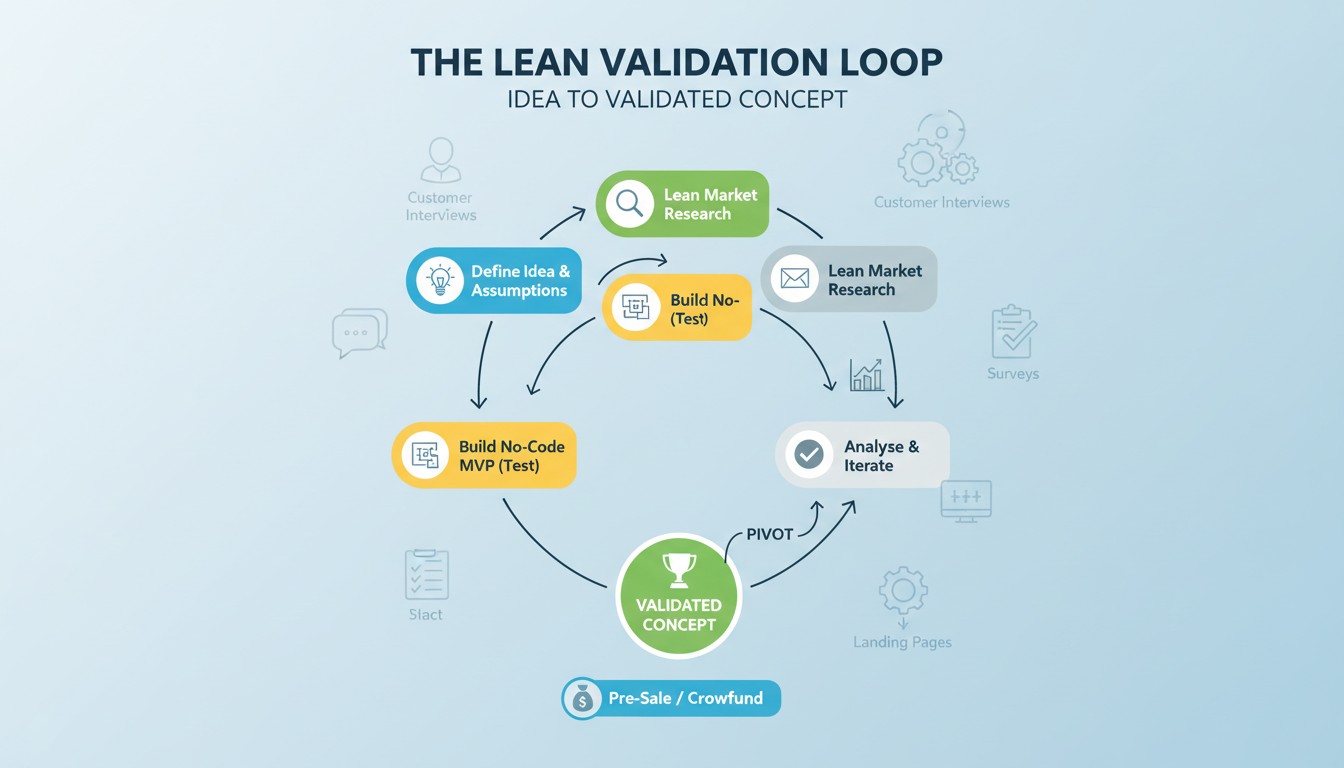
The startup cemetery isn’t filled with lazy ideas—it’s filled with unproven assumptions. According to CB Insights’ post-mortem analysis, 42% of startups die because they solve problems nobody cares enough to pay for. Yet founders continue sinking cash into sleek prototypes and legal structures before confirming a single stranger feels the pain. The validation void creates a paradox: the most business-critical activity receives the least effort, while we obsess over LLC filings and color palettes that could wait.
Zero-cost validation isn’t frugality—it’s a strategic weapon. It transforms entrepreneurial hallucination into market intelligence, belief into evidence, and ego-driven building into customer-driven design. Mastering validation without opening your wallet rewires your founder DNA to seek proof before passion. The invisible foundation of every successful venture is validation, not vision boards.
The Assumption Trap: How Unvalidated Beliefs Bankrupt Founders
Every business plan sits on a Jenga tower of assumptions—problem severity, customer urgency, pricing tolerance, competitive gaps. When these blocks remain unprobed, even the most brilliant strategy collapses under the weight of reality. The founder who spends three months perfecting a CRM for freelancers discovers too late that freelancers don’t want another subscription—they want clients. The tower topples.
Consider the entrepreneur who drops $30,000 developing a meal-planning app with AI-generated recipes. At launch, signups trickle because busy parents—the target market—don’t need more recipes; they need someone to physically grocery shop. Meanwhile, a competitor spends $0 on development, creates a simple Tally form connecting parents with college students who will shop for them, and hits $10K MRR in 60 days. The difference wasn’t technology—it was validation discipline.
The downstream impact of early validation is exponential. A founder who conducts 40 discovery interviews understands the exact language customers use to describe pain—which becomes conversion copy. They learn price resistance thresholds—which informs freemium strategy. They identify deal-breaker features—which guides the roadmap. The unvalidated founder builds in a vacuum, then wastes months retrofitting their product to unfamiliar market logic.
The Assumption Jenga Stack
Block 1: Your target customer experiences this problem weekly
Block 2: They currently pay for a subpar solution
Block 3: They have budget authority to try new tools
Block 4: Your solution is 10x better, not just different
Block 5: They’ll switch within 30 days of seeing your product
The Founder Blindspot: Why Smart People Build Dumb Things
If validation is so logical, why do experienced professionals repeatedly skip it? The culprit is a psychological minefield of biases, mythology, and the raw thrill of making over measuring. Humans are hardwired to favor action over analysis, especially when we’ve already told everyone we’re building the next big thing.
The Builder’s Bias: We Worship Our Creations
Behavioral economists call this the endowment effect—once we create something, we overvalue it by 300%. That feature you coded at 2 AM isn’t just code; it’s your baby. Validation feels like asking someone to critique your newborn’s face. So you avoid it. The founder who sketches a solution on paper and shows it to 10 prospects feels no such attachment—they can crumple and restart in seconds.
This bias is turbocharged by startup culture’s “ship it” mantra. First Round Review highlights how founders mistake motion for meaning, building features as a proxy for making progress. But shipping the wrong product is like driving faster in the wrong direction—you’re not making progress, you’re increasing the distance to your real destination.
The Expertise Trap: When Knowledge Becomes a Cage
Paradoxically, deep domain expertise often prevents validation. The attorney who builds a practice management tool assumes every lawyer shares their workflow frustrations. But their experience is a sample size of one with extreme bias. They skip customer interviews because “I am the customer,” missing that their pain is often unique. The outsider who interviews 50 lawyers discovers that client intake, not case management, is the universal bottleneck.
This “curse of knowledge” leads to what venture coach Cindy Alvarez calls “solution-first thinking”—falling in love with your answer before fully understanding the question. The result is always the same: a dramatic pivot after burning resources, when early validation could have pointed to the right path from day one.
The Pain-First Principle: Excavating Tier 1 Problems
Zero-cost validation demands fanatical problem focus. Before wireframes, before pitch decks, before business cards, you must unearth a problem so acute your target customer would sacrifice their lunch break to solve it. This is what Startup Grind’s validation framework calls a “hair-on-fire” problem, and it’s the difference between products that print money and those that collect dust.
Mining this problem requires investigative journalism, not creative brainstorming. Lurk where your potential customers suffer: niche subreddits, industry Discord servers, LinkedIn rant posts, Amazon reviews of competing products. Don’t ask “what bugs you?” Ask “what made you want to throw your laptop out the window this month?” These questions surface hemorrhaging pain, not mosquito-bite annoyances.
A founder wanted to build AI-powered contract analysis for small businesses. Instead of coding, he spent two weeks in legal help forums. He noticed contractors didn’t struggle with contract review—they struggled with getting clients to sign contracts at all. The real Tier 1 problem was proposal-to-signature friction. He pivoted to a simple e-signature workflow and had paying customers in 10 days. Zero code, zero cost, laser-focused on real pain.
The 30-Interview Rule for Problem Clarity
Your validation North Star: 30 deep-dive conversations with your precise target customer. Not google forms—human dialogue. Use LinkedIn Sales Navigator to filter by job title, company size, pain indicators. Send a humble message: “I’m a founder researching [specific problem area]. I’d love to learn from your experience—15 minutes, no pitch, just listening.” Offer a $25 Amazon card if you want, but genuine curiosity often beats compensation.
During these calls, follow the 90/10 rule: spend 90% of the time excavating their problem, 10% testing your solution hypothesis. Ask “Tell me about the last time that happened” and “What have you tried to fix it?” Transcribe the calls using Otter.ai (free tier). If 25 out of 30 use the same phrase to describe their frustration, you’ve struck a nerve. That’s your marketing copy, your product spec, your validation gold.
The Validation Ladder: From Curiosity to Cash
Step 1: 30 interviews confirm relentless problem (Cost: $0 + your time)
Step 2: 100 people join waitlist via landing page (Cost: $0 with Linktree)
Step 3: 15 people verbally commit to pre-order (Cost: $0)
Step 4: 8 actually pay for your manual MVP (Cost: $0 if you invoice via Stripe)
The Wizard of Oz MVP: Faking It to Make It
The most capital-efficient validation is delivering your solution manually while appearing automated. If your idea is an AI resume reviewer, don’t build machine learning models. Have a Google Form collect resumes, manually review them using a structured rubric, and send feedback within 24 hours. Customers get value; you get insight. The moment you can’t keep up manually is your market validation.
Dropbox’s legendary validation is the textbook example. Drew Houston didn’t build the sync engine first. He created a 4-minute demo video showing the concept and posted it on Hacker News. Overnight, 75,000 people signed up for a beta that didn’t exist. That wasn’t a product launch—it was a demand test. The video cost $0 to make (just screen recording software) and proved a market hunger that justified the engineering effort.
The Concierge Protocol
Hand-deliver your solution to five customers, personally, for free. Become their temporary employee. Shadow their workflow. Document every friction point. Notice what makes them smile—that’s your moat. Notice what makes them shrug—that’s dead weight. This approach costs nothing but time and produces insights no survey could capture because you’re embedded in the messy reality of their process.
A founder envisioned a subscription box for remote workers. Instead of sourcing products and building a Shopify store, she manually curated five boxes for five remote employees. She delivered them by hand, watched them unbox, and noticed the real delight came from the handwritten note explaining each product’s remote-work benefit—not the products themselves. She pivoted to a “curation-as-a-service” model for HR teams, 10x-ing her margins before spending a dollar on inventory.
Digital Smoke Signals: Reading Market Heat at Scale
Once you’ve validated through manual service, test at scale without automation. Digital tools emit smoke signals that reveal market fire before you commit resources. The key is tracking commitment metrics, not vanity numbers.
Build a simple landing page with Strikingly and describe your solution in plain English. Include three pricing tiers. Share it in niche Reddit communities, Slack groups, and LinkedIn posts. Don’t track page visits—track clicks on the “Buy Now” button. If 8% of visitors click pricing, you have commercial interest. If 0.5% click, you have a hobby.
The Shadow Payment Button
The ultimate validation signal is payment intent. Create a pricing page where the “Subscribe” button leads to a form: “We’re launching soon! Join the founding members list for 50% off.” Capture emails. If 50+ people submit, you have financial validation. If 2 people submit, you’ve saved yourself from building a payment system for a ghost market.
A founder tested a $99/month SaaS idea for podcasters. His shadow payment form collected 200 emails in one week from a single niche Facebook group. When he manually invoiced the first 20 people, 18 paid. He hadn’t written a line of code, yet he had $1,800 in pre-launch revenue and absolute confidence to quit his job and build.
Real-World Validation Hacks That Cost $0
Dropbox: Video demo → 75K signups → proved sync desire before servers
Zappos: Took shoe photos at local stores → posted online → bought only after order confirmed
Buffer: Landing page with pricing → tracked clicks → knew willingness to pay
Product Hunt: Started as Ryan Hoover’s email list → manual curation → proved community hunger
Gumroad: Manual payment links → artist demand pulled automation from manual work
The Validation Resistance: Why Evidence Scares Us More Than Failure
Here’s the psychological twist: founders avoid validation not because it’s difficult, but because it introduces the possibility of a “no.” A “no” threatens the founder identity you’ve already broadcast on LinkedIn and at meetups. Building in stealth feels safer because you can maintain the illusion of inevitable success until launch day, when failure can be blamed on execution, not the idea itself.
The Ego Risk vs. The Financial Risk
Validation forces you to risk your ego now to avoid risking your bank account later. Most founders choose the reverse—they protect their ego by avoiding customer conversations, then risk everything on a product nobody validated. This is backward. The founder who interviews 50 prospects and discovers there’s no market feels a temporary sting. The founder who builds for a year and hears crickets at launch feels that same sting, plus bankruptcy.
The 30-Day Validation Sprint: Your Action Plan
Week 1: Live in their world. Join 10 communities. Document 50 pain points. Identify the top 3 recurring nightmares.
Week 2: Interview 30 humans. Ask “walk me through the last time you dealt with this.” Shut up and listen. Transcribe everything.
Week 3: Build a “shadow product.” Landing page. Pricing. Waitlist. Drive 500 visitors from organic posts. Measure clicks, not compliments.
Week 4: Invoice 20 people manually. If 10 pay, you have a business. If zero pay, you have a lesson. Both are wins.
Your Zero-Cost Validation Toolkit: The Essentials
You don’t need a budget to validate—you need a browser and discipline. Here’s your free tool stack:
Customer Discovery: LinkedIn (free tier) + Reddit + niche Slack communities. Search “[your market] + frustrated” or “[your market] + struggling.”
Interview Scheduling: Calendly free tier. Removes friction. Shows professionalism.
Transcription & Analysis: Otter.ai free plan. Turns calls into searchable text. Pattern recognition goldmine.
Landing Pages: Carrd (free) or Linktree. Track button clicks with Google Analytics (free).
Payment Intent: Gumroad free tier or PayPal invoicing. Test willingness to pay without a merchant account.
Community Access: Facebook Groups, Subreddits, Indie Hackers, Product Hunt. Your customers are already talking. Just listen.
The Market Is Already Speaking. Are You Listening?
Your future customers are right now complaining about problems on Reddit, in Slack channels, in LinkedIn comments. They’re voting with their frustration, telling you exactly what they’ll pay to make disappear. You don’t need to guess. You need to listen.
Zero-cost validation isn’t a hack or a shortcut—it’s the foundation of sustainable business. The founders who skip it aren’t brave visionaries; they’re gamblers betting their savings on a hunch. The founders who validate aren’t timid or slow; they’re architects building on solid ground.
Your next move isn’t to open your IDE or incorporate your LLC. Your next move is to find one person in your target market and ask them one question about their biggest frustration. That conversation costs $0 and could save you $50,000. The market is giving you the answers. It’s time to start taking notes.