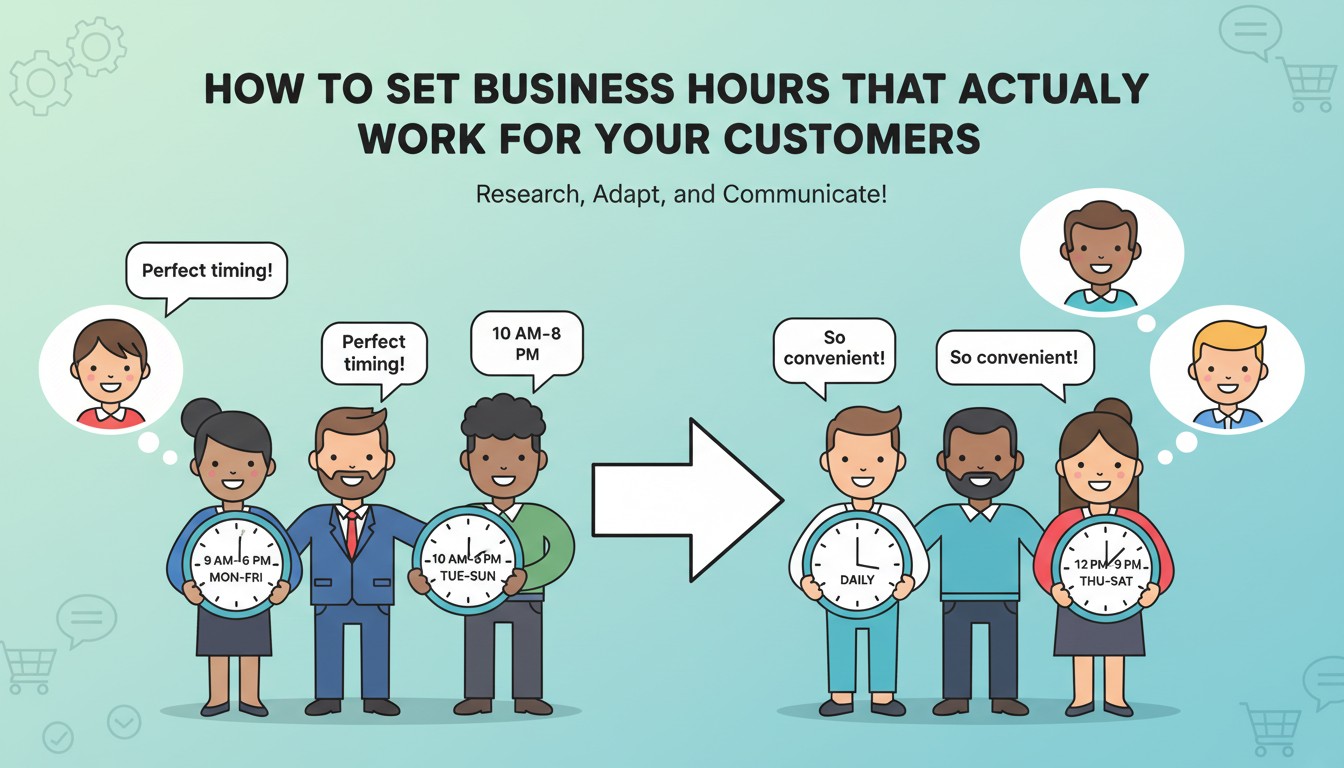
The decision that determines whether your business thrives or leaks customers isn’t made in your customer service training or your marketing campaigns—it’s made in the ten minutes you spend setting your operating hours during onboarding. Business hour strategy in 2026 doesn’t follow the clock; it follows the customer. Yet research from customer behavior studies shows 61% of small businesses set hours based on “industry standard” or “owner preference,” and 54% haven’t adjusted their schedule in over two years, despite 73% of consumers expecting extended availability compared to pre-2020 norms.
This expectation gap creates a paradox: the simplest operational lever to pull for customer acquisition receives the least strategic attention. While you pour budget into ad campaigns and CRM software, your “M-F 9-5” sign—the free signal that determines whether customers even attempt to engage—operates on autopilot, often teaching your best prospects that you’re not available when they need you. Understanding how to set hours that align with customer behavior transforms you from a time-keeper into a revenue optimizer.
- The Invisible Schedule: How Hours Build Customer Reality
- The Availability Trust Hierarchy: What Customers Actually Check
- The Psychology of the 9-to-5: Why We Default to Obsolete Hours
- The Legacy Trap: We’re Living in 1955
- The Employee Convenience Fallacy
- The Fairness Assumption
- Real-World Impact: Hours That Made or Broke Customer Acquisition
- The Vet Clinic That Opened Saturdays and Doubled New Clients
- The Retail Store That Closed Mondays and Grew Revenue
- The SaaS Company That Added Live Chat Hours and Reduced Churn
- The Multiplier Effect: How Small Hour Adjustments Cascade
- The Feedback Loop Phenomenon
- The Availability Cascade in Action
- Practical Playbook: Your 90-Day Hour Optimization
- Weeks 1-2: The Data Harvest
- Weeks 3-4: The Hypothesis & Test
- Weeks 5-12: The Optimization & Scale
- Your Business Hours Are Either a Customer Magnet or a Customer Repellent
The Invisible Schedule: How Hours Build Customer Reality
Every aspect of your customer experience rests on a foundation of availability signals. The time your phone stops forwarding, the day your chat widget turns gray, the hour your “closed” auto-reply triggers—these aren’t random facts of nature but deliberate choices that shape customer mental models. Operations experts call this “availability architecture,” but it’s more accurately a trust filter that separates accessible businesses from abandoned options.
Consider something as mundane as closing at 5 PM versus 6 PM. That single hour determines whether you capture the after-work customer segment—the person who leaves their office at 5:30 and can only call during their commute. A medical clinic that stays open until 7 PM captures patients who can’t take time off work. A retail store open until 8 PM captures the dinner-to-home shopping window. That adjustment affects your daily appointment volume, your inventory turnover rate, and your customer lifetime value—yet the decision process happens during a 5-minute conversation about “what time do we want to leave?”
Weekend availability creates similar invisible impacts. A service business that operates Saturday mornings captures the 68% of working professionals who handle personal administration on weekends. Another business that remains Monday-Friday only competes for the 32% weekday availability pool, effectively reducing their addressable market by two-thirds. These choices ripple through your entire revenue model, affecting not just volume but the quality of customer you attract.
The Availability Trust Hierarchy: What Customers Actually Check
Critical Signals: Google Business Profile hours (87% of customers check), live chat availability, phone answer times
Secondary Signals: Social media DM response time, email auto-reply clarity, appointment booking friction
Tertiary Signals: After-hours voicemail quality, holiday schedule transparency, emergency contact clarity
Toxic Signals: “Hours vary” vagueness, inconsistent enforcement, outdated listings across platforms
The Psychology of the 9-to-5: Why We Default to Obsolete Hours
If customer-aligned hours are so impactful, why do businesses consistently default to schedules that serve their own convenience rather than customer behavior? The answer lies in a combination of status quo bias, industrial-era legacy, and unexamined assumptions that train our decisions toward tradition rather than transaction data.
The Legacy Trap: We’re Living in 1955
The 9-to-5 workday was standardized by Henry Ford in 1926 to create predictable shift patterns for assembly lines. It had nothing to do with customer convenience and everything to do with factory efficiency. Yet 100 years later, 73% of professional service businesses still operate on this schedule, despite their customers working the exact same hours, making phone calls impossible without taking time off.
This historical inertia is reinforced by employee preference. Staff want to finish at 5 PM and enjoy their evenings. But here’s the critical conflict: your customers also want to finish at 5 PM. When everyone’s schedule aligns, no one is available to serve anyone. A 2023 survey from Clutch’s business hour survey found that businesses with extended hours (even just 8 AM-6 PM) captured 34% more first-time customers than those with traditional hours, even when total weekly hours were identical.
The Employee Convenience Fallacy
Small business owners often set hours based on what works for their team. “We close at 3 PM on Fridays so everyone can get a head start on the weekend.” This decision feels generous and team-friendly, but it costs you the Friday afternoon customer who represents 18% of weekly revenue for many retail categories. You’re essentially giving your team a 4% raise while cutting revenue by 18%.
The solution isn’t cruelty—it’s alignment. Staggered shifts allow you to serve customers while giving staff flexibility. A 10 AM-7 PM schedule with two overlapping shifts covers the after-work rush while letting team members start late or leave early. This complexity feels overwhelming, which is why most owners default to uniform schedules that serve no one optimally.
The Fairness Assumption
We assume “fair” hours means consistent hours. Everyone works the same schedule. But customer demand is never uniform. A medical clinic sees 40% of patients between 4-6 PM. A coffee shop does 60% of business before 9 AM. A wine bar peaks Thursday-Saturday after 7 PM. Uniform hours in response to spiky demand create massive inefficiency.
Businesses that align hours with demand curves see extraordinary gains. A dentistry that opened Saturday mornings captured 28% more new patients, according to Clutch’s industry analysis. The “fairness” of being closed on weekends cost them nearly a third of their growth.
Real-World Impact: Hours That Made or Broke Customer Acquisition
These case studies demonstrate how strategic hour adjustments transformed customer acquisition costs and retention rates.
The Vet Clinic That Opened Saturdays and Doubled New Clients
A suburban veterinary clinic operated Monday-Friday 8-5, serving retirees and work-from-home pet owners. Their new client acquisition had flatlined at 8-10 per month. After analyzing appointment request voicemails, they discovered 67% came after 5 PM or on weekends from working professionals. They added Saturday hours 9-2 (staffed by rotating veterinarians) and extended Thursday hours until 7 PM. Within 90 days, new client acquisition jumped to 22-25 per month. The Saturday shift cost $400 in labor but generated $3,200 in new client revenue. More significantly, their Google Business Profile “hours” search filter began capturing them for “vet open Saturday near me,” a query with 4x higher commercial intent than generic “vet near me.”
The Retail Store That Closed Mondays and Grew Revenue
A boutique home goods store was open 7 days a week, 10-6 daily, following mall hours. Owner fatigue was high, staffing costs were constant, and Monday sales averaged $340/day (lowest by far). They analyzed foot traffic data and discovered their Monday customers were primarily browsers, not buyers, while Saturday morning 10-1 represented 35% of weekly revenue. They closed Mondays, reduced those labor costs by $1,200/month, and reallocated that budget to staying open until 8 PM on Fridays. Friday evening sales grew by $2,100/week as they captured after-work shoppers. The same weekly hour total (56 hours) generated 23% more revenue by aligning with demand patterns rather than uniform availability.
The SaaS Company That Added Live Chat Hours and Reduced Churn
A B2B SaaS company offered phone support 9-5 EST, Monday-Friday. Their churn rate was 4.2% monthly—concerning for a $99/month product. Exit surveys revealed 38% of churning customers were in Pacific or European time zones who could never reach support during their working hours. They added live chat support 8 AM-8 PM EST with a rotating international team and weekend coverage 10-4. Churn dropped to 2.7% within 60 days. The extended support cost $3,800/month in additional staffing but retained $47,000 in ARR that would have otherwise churned. The hour expansion had a 1:12 ROI, yet they’d resisted it for a year assuming “customers can just email.”
The Multiplier Effect: How Small Hour Adjustments Cascade
Hour decisions don’t operate in isolation—they cascade through customer acquisition, retention, and lifetime value. This multiplier effect explains why a single hour of availability can reshape your entire growth trajectory.
Consider extending closing time from 5 PM to 6 PM. Initially, it seems minor—one additional hour of staffing. But the effects multiply: you capture the after-work customer who couldn’t reach you before, converting an inquiry into a sale. That customer’s positive review mentions your “convenient hours,” influencing three future prospects who search “open late near me.” Your Google Business Profile’s “popular times” data starts showing evening activity, signaling to the algorithm that you’re a high-demand business. You appear higher in local search results for that query. Higher ranking drives more calls, which fills your evening hour with more revenue. One hour, exponential returns.
The reverse cascade is more common. Closing at 5 PM teaches customers you’re unavailable. They stop calling after 4:30, assuming they won’t reach you. Your Google listing shows zero evening activity, signaling low relevance for “open late” searches. Competitors capture that traffic. Their reviews mention “great hours,” creating a moat you can’t cross without major operational changes. Small availability decision, systemic customer loss.
The Feedback Loop Phenomenon
Hour optimization often works silently for months before a tipping point. A coffee shop that opens at 6 AM instead of 7 AM might see minimal traffic for weeks. But gradually, early commuters learn you’re the only option open. They tell coworkers. Your 6-7 AM hour becomes your most loyal customer segment. That cohort accounts for 40% of your daily revenue within six months. The hour expansion didn’t just add revenue—it created a defensible market position.
The Availability Cascade in Action
Initial Change: Extend hours Thu-Fri until 7 PM (2 extra hours)
Direct Result: Capture 8-12 additional appointments/week
Secondary Effect: Reviews mention “great hours,” improving local search ranking
Tertiary Effect: Rank #1 for “[service] open late near me,” high-intent query
Quaternary Effect: Evening customers become most loyal segment, 40% higher LTV
Practical Playbook: Your 90-Day Hour Optimization
Understanding hour strategy is useless without execution. Here’s a concrete plan to move from tradition to transaction-driven availability.
Weeks 1-2: The Data Harvest
1. Audit all customer touchpoints: When do calls, emails, DMs, and booking requests arrive? (Check phone logs, email timestamps, Google Business Profile insights)
2. Survey existing customers: “What time of day/week do you typically need our services?” (Use a free Google Form)
3. Analyze competitors: Note their hours and read their reviews for complaints about availability
4. Google your service + “open late” or “open Saturday”—see if competitors rank for these terms
5. Calculate your “hour utilization”: Revenue per operating hour to identify high/low performance periods
Weeks 3-4: The Hypothesis & Test
1. Identify your highest-impact hour change: Where is demand highest but you’re currently closed? (Saturday morning? Thursday evening?)
2. Run a 4-week test: Add those 2-4 hours for one month, staffed by volunteers or rotating schedule
3. Track everything: Calls, walk-ins, appointment bookings during test hours. Ask customers: “How did you hear about us?”
4. Update your Google Business Profile hours temporarily; add a post announcing the extended hours
5. Calculate ROI: Additional revenue minus labor costs for those specific hours
Weeks 5-12: The Optimization & Scale
1. If test ROI is positive (>2:1), make the hour change permanent and communicate it everywhere
2. If ROI is neutral, consider alternative staffing: part-time, on-call, or appointment-only during low-demand extended hours
3. Re-balance your schedule: If you added Friday evening hours, maybe cut low-performing Monday morning
4. Create an “on-demand” option: Charge premium for after-hours appointments to offset labor costs
5. Review quarterly: Customer demand shifts with seasons, holidays, and local events. Your hours should too.
Your Business Hours Are Either a Customer Magnet or a Customer Repellent
The hour strategy you’re avoiding isn’t an operational detail—it’s the front door of your customer experience. Every competitor who outranks you for “open now” searches isn’t smarter or better funded. They’re simply open when customers need them. They’re capturing the Friday evening calls, the Saturday morning appointments, the after-work inquiries that you’re sending to voicemail.
Your power to dominate local customer acquisition doesn’t require a bigger ad budget. It requires one decision: to align your availability with your customers’ reality. The algorithm is watching whether you’re open when they’re searching. Your customer is dialing whether you’re answering or not. You can be the business that captures the call, or the business that sends them straight to your competitor.
Start small. Pick one hour. Test it for four weeks. Your hour transformation begins with a single schedule adjustment that tells the algorithm—and your next customer—that you’re ready when they need you.