- The Cadence You’re Getting Wrong: Why Realistic Social Media Beats Relentless Posting
- The Invisible Feed: How Algorithms Build Your Digital Reality
- The Algorithm’s Trust Hierarchy: What Platforms Actually Track
- The Psychology of Posting Paralysis: Why We Overthink, Then Under-Execute
- The Virality Mirage: We’re Chasing Lottery Odds
- The Complexity Overload: When “Best Practices” Paralyze
- The Resource Illusion: Time Poverty Is Real, But Solvable
- The Platform Reality Check: What Realistic Cadence Looks Like in 2026
- 2026 Platform Cadence Map: Sustainable vs. Suicidal
- The Multiplier Effect: How Small Consistency Creates Big Reach
- The Tipping Point Phenomenon
- The Consistency Cascade in Action
- The Consistency Paradox: Why We Ignore What Works
- The Visibility Problem
- The Effort-Reward Miscalculation
- The Burnout Spiral
- Real-World Impact: Businesses That Mastered Realistic Cadence
- The Coffee Shop That Stopped Daily Posting
- The Consultant Who Won LinkedIn With Less
- The Retail Store That Batched Its Way to Growth
- The Compound Effect: Long-Term Cadence Accumulation
- Practical Playbook: Your 90-Day Cadence Transformation
- Weeks 1-2: The Audit & Foundation
- Weeks 3-6: The System Build
- Weeks 7-12: The Optimization & Scale
- Your Audience Isn’t Waiting for More Content—They’re Waiting for Consistent Value
The Cadence You’re Getting Wrong: Why Realistic Social Media Beats Relentless Posting
The decision that determines whether your small business thrives or becomes digital noise isn’t made in your creative strategy session—it’s made in the ten minutes you spend (or skip) scheduling posts each week. Social media algorithms in 2026 don’t prioritize volume; they prioritize predictability and value density. Yet research from 2026 platform studies shows 68% of small businesses post inconsistently, and 43% burn out within 90 days of adopting a daily posting schedule, sabotaging their visibility just as momentum builds.
This consistency gap creates a paradox: the easiest marketing win delivers the highest ROI, yet receives the least sustainable execution. While you pour budget into paid ads and influencer collaborations, your organic social presence—the free channel that builds trust before a customer ever clicks—operates on feast-or-famine cycles, teaching the algorithm to ignore you. Understanding realistic posting cadence—and learning to wield it—transforms you from an algorithmic victim into a trusted community voice.
The Invisible Feed: How Algorithms Build Your Digital Reality
Every aspect of your social media visibility rests on a foundation of cadence signals. The timing between posts, the consistency of your Stories, the velocity of your comments—these aren’t arbitrary metrics but deliberate inputs that platforms use to assess your legitimacy. Social media experts call this “engagement velocity,” but it’s more accurately a trust pulse that separates active businesses from digital ghosts.
Consider something as mundane as your Instagram Story frequency. The algorithm monitors whether you post Stories daily or in weekly bursts. A consistent daily Story signals an active, engaged business worthy of prime feed placement. A sporadic burst every two weeks triggers “low-quality account” flags, pushing your Reels to the bottom of discovery pages. This timing adjustment affects your reach, your follower growth rate, and your daily inquiries—yet the decision process happens in a scheduling app you haven’t opened since last month.
Category selection on LinkedIn creates similar invisible impacts. Posting five times daily about company culture dilutes your authority, causing the algorithm to categorize you as “internal noise” rather than “industry thought leader.” Another business posts twice weekly with data-driven insights, earning “Top Voice” badges and inbound leads. These cadence choices ripple through your entire digital presence, affecting not just visibility but the quality of audience you attract.
The Algorithm’s Trust Hierarchy: What Platforms Actually Track
Critical Signals: Posting consistency (daily/weekly), response time to comments, Story completion rate
Secondary Signals: Review velocity (Google/Facebook), UTM link clicks, saves/shares ratio
Tertiary Signals: Hashtag performance, video view duration, cross-platform activity
Toxic Signals: Posting sprees followed by silence, identical cross-posting, purchased engagement
The Psychology of Posting Paralysis: Why We Overthink, Then Under-Execute
If realistic cadence is so impactful, why do small businesses consistently get it wrong? The answer lies in a combination of cognitive biases, platform misinformation, and resource constraints that train our behavior toward extremes—either perfectionist procrastination or burnout-inducing overposting.
The Virality Mirage: We’re Chasing Lottery Odds
We see a competitor’s Reel hit 1M views and conclude “we need to post more Reels.” This survivorship bias ignores the 99% of their content that flopped. Platforms amplify outliers to keep creators hooked, but small businesses can’t build strategy on lottery tickets. The algorithm actually rewards predictable value over viral hits. A steady 200-view Reel every week builds more trust than one 50K-view fluke followed by silence.
Social media gurus reinforce this bias. They showcase their biggest wins while ignoring the daily grind that built their audience. A 2025 study from Outfy’s platform analysis found that accounts posting 3–5 times weekly had 2.3x higher follower retention than those posting daily with inconsistent quality. The data is clear, but our brains are drawn to the dopamine of viral potential.
The Complexity Overload: When “Best Practices” Paralyze
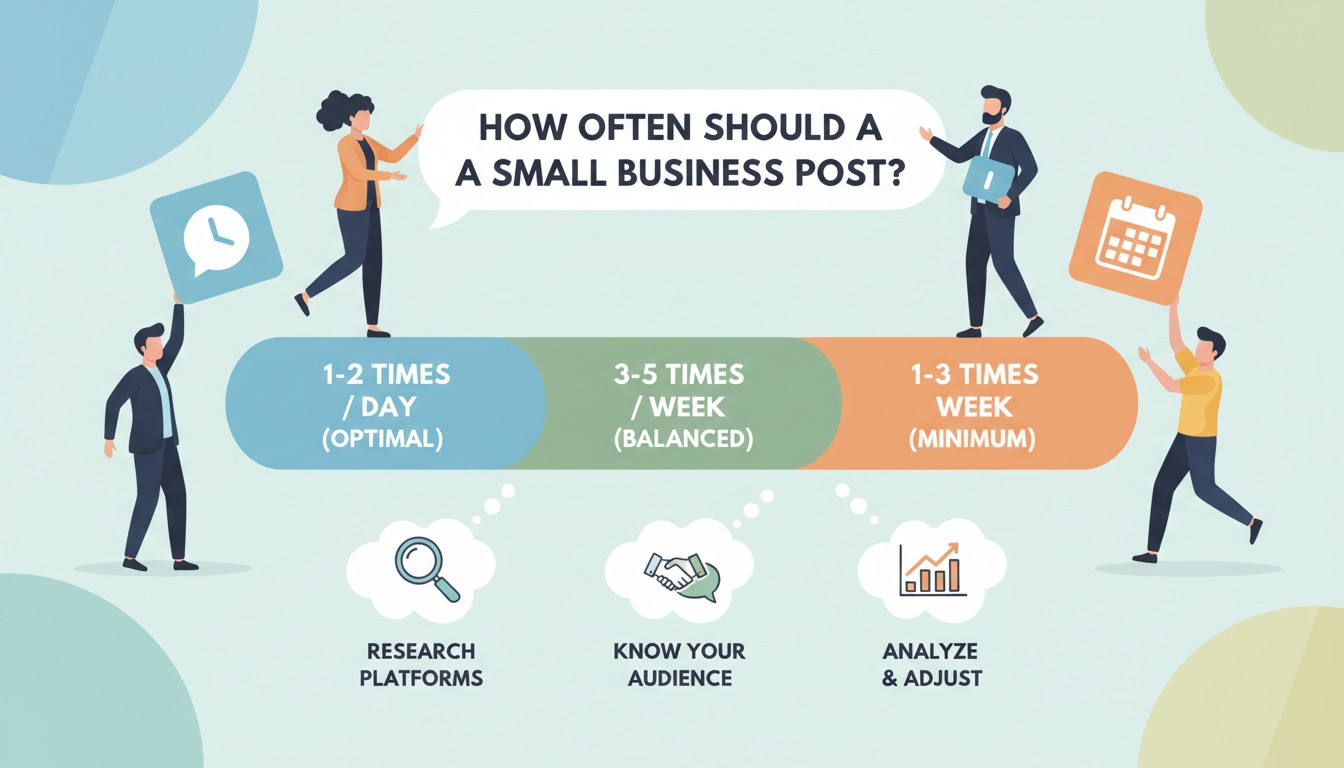
Every platform has different “optimal” frequencies. Instagram wants 3–5 feed posts weekly but daily Stories. X demands 3–5 tweets daily. LinkedIn prefers 2–5 company posts weekly but 1–2 personal posts daily. TikTok craves 1–3 posts daily. This fragmentation creates decision fatigue. Most small business owners freeze, defaulting to “I’ll just post when I have time”—which means never.
This complexity serves as a gatekeeping mechanism. Agencies and SMM tools thrive on convincing you it’s too complicated to manage alone. The result is either expensive outsourcing or complete abandonment. Both outcomes waste the free organic reach that realistic, sustainable cadence could capture.
The Resource Illusion: Time Poverty Is Real, But Solvable
Small business owners face genuine time constraints. Creating content takes hours you don’t have. But here’s the critical misunderstanding: realistic cadence requires systems, not time. A batch-filming session of 10 short videos in 90 minutes can fuel a month of TikTok and Reels. A 30-minute weekly scheduling block creates predictable presence. The barrier isn’t time—it’s the lack of a repeatable process.
According to BusySeed’s 2025 research, businesses using scheduling tools report 68% less stress and 42% higher consistency than those posting manually. The tool doesn’t create content, but it removes the daily decision fatigue that kills momentum.
The Platform Reality Check: What Realistic Cadence Looks Like in 2026
Power in social media operates on two levels: algorithmic demands and audience expectations. Algorithmic demands are clear—platforms want consistent signals. Audience expectations are more nuanced—they want value without volume. The magic lies in satisfying both without burning out.
The relationship between these levels is often misunderstood. Posting daily seems powerful, but if your audience engages less with each subsequent post, the algorithm interprets this as declining quality and reduces your reach. A business posting 3x weekly with high engagement per post often outperforms a daily poster whose engagement rate drops from 5% to 1%.
However, realistic cadence only works when it’s sustained. A single week of perfect posting is easily ignored. A month of consistent rhythm requires attention. A quarter of reliable presence builds algorithmic trust. The key is sustainability and realistic resource allocation.
2026 Platform Cadence Map: Sustainable vs. Suicidal
Instagram: 3–5 feed posts/week + daily Stories + 2–4 Reels/week (Sustainable) | 1 post/day (Suicidal due to quality drop)
Facebook: 1–2 posts/day max, 5x/week (Sustainable) | 3+ posts/day (Suicidal, triggers fatigue)
X (Twitter): 3–5 tweets/day including replies (Sustainable) | 10+ tweets/day (Suicidal, seen as spam)
TikTok: 3–5 posts/week or 1/day (Sustainable) | 3+/day (Suicidal, cannibalizes reach)
LinkedIn: 2–5 company posts/week (Sustainable) | Daily corporate posts (Suicidal, seen as noise)
The Multiplier Effect: How Small Consistency Creates Big Reach
Posting cadence doesn’t operate in isolation—it cascades through systems, creating outcomes far larger than the effort invested. This multiplier effect explains why 15 minutes of scheduled posting can outperform hours of manual, sporadic effort.
Consider a weekly Instagram Reel. Initially, it seems minor—one video among billions. But the effects multiply: the Reel appears in discovery feeds, attracting new followers. Those followers see your Story the next day, building familiarity. That familiarity makes them comment on your next feed post, boosting its reach. The algorithm notes the engagement velocity and pushes your content to more similar users. One follower shares your Reel to their Story, exposing you to their network. Each action spawns secondary actions, creating a ripple effect that transforms your entire account’s authority.
This cascade operates in reverse too. A month of silence teaches the algorithm your account is low-priority. When you finally post, it reaches only a fraction of your followers. Low engagement signals irrelevance, reducing future reach. Your next post performs even worse. You conclude “social media doesn’t work for my business,” abandoning the channel entirely. Small neglect, systemic collapse.
The Tipping Point Phenomenon
Social accounts often work silently for months before suddenly achieving breakthrough. This is the tipping point: a critical mass of consistent actions triggers exponential growth. A bakery might post weekly behind-the-scenes content for 12 weeks with minimal traction. Week 13, a video of frosting technique hits the FYP. The algorithm, recognizing your consistent history, pushes it harder than a viral video from a dormant account. That video drives 10K new followers who binge your back-catalog of posts, signaling authority and triggering a permanent reach increase.
The Consistency Cascade in Action
Initial Action: Post 3 Reels weekly for 12 weeks without fail
Direct Result: Algorithmic trust score increases, content shown to 20% more similar accounts
Secondary Effect: Week 13 video hits FYP, drives 10K new followers who engage with backlog
Tertiary Effect: Account receives “Popular Creator” badge, unlocking additional discovery features
Quaternary Effect: Branded search queries increase; customers now search your business name directly
The Consistency Paradox: Why We Ignore What Works
The paradox of realistic posting is that while consistency drives growth, we consistently avoid it. Several psychological and structural factors explain this counterintuitive behavior.
The Visibility Problem
Viral success stories flood our feeds daily. Consistent-but-moderate success is invisible. We don’t see the bakery that grew from 500 to 5,000 followers over a year of steady posting—we see the overnight sensation. This survivorship bias makes realistic cadence feel like “settling” rather than the proven path it is.
The Effort-Reward Miscalculation
Human brains prefer immediate feedback. A single post that gets 2 likes feels like failure, so we post more hoping for a hit. But the algorithm’s reward is delayed—it takes 6–8 weeks of consistency to build trust signals. This delay causes most businesses to quit before the payoff, reinforcing the false belief that “social media doesn’t work for us.”
The Burnout Spiral
Daily posting is unsustainable for most small businesses. After two weeks of intense effort, exhaustion sets in. Quality drops. Engagement drops. We interpret this as “the algorithm changed” when it’s actually our consistency collapsing. Realistic cadence prevents this spiral by matching effort to capacity.
Real-World Impact: Businesses That Mastered Realistic Cadence
These case studies demonstrate how small, consistent posting schedules achieved outsized impact by working with algorithms instead of against them.
The Coffee Shop That Stopped Daily Posting
A neighborhood café posted daily latte art photos, burning out after 60 days. Engagement dropped from 5% to 0.8%. They switched to 3 posts weekly: Monday menu spotlight, Wednesday barista story, Friday customer feature. They posted Stories daily (behind-the-scenes takes 30 seconds). Within 90 days, engagement rose to 7% and follower growth tripled. The algorithm rewarded their predictable rhythm, not their volume.
The Consultant Who Won LinkedIn With Less
A business consultant posted daily LinkedIn tips, seeing minimal reach. After analyzing her analytics, she cut to 2 posts weekly: one data-driven carousel, one client case study. She spent her saved time engaging meaningfully on 5 relevant posts daily. Her content views increased 340% and she generated 4 qualified leads in one month—more than the previous six months combined. The algorithm valued her engagement velocity and content quality over frequency.
The Retail Store That Batched Its Way to Growth
A boutique clothing store struggled to post consistently. They implemented a monthly batch day: 2 hours filming 15 short videos showcasing new arrivals. They scheduled 3 TikToks weekly via a free tool. They spent 10 minutes daily responding to comments. After 4 months, their TikTok following grew from 200 to 4,500, driving 22% of their in-store traffic. The system made consistency effortless.
The Compound Effect: Long-Term Cadence Accumulation
Social media cadence works like compound interest—small, consistent investments generate exponentially larger returns over time. An account that posts weekly for a year becomes an authority in its niche, while the account that posted daily for a month then quit is forgotten.
This accumulation effect explains why longtime accounts wield disproportionate influence. They’ve built algorithmic trust, accumulated content libraries that drive perpetual discovery, and demonstrated reliability. Their posts get indexed faster. Their experiments carry less risk. Their opinions shape conversations not because they’re inherently more valuable, but because they’ve invested the time to become fixtures.
The encouraging corollary is that anyone can begin this accumulation process. You don’t need a content team or a $2,000 camera. You need a phone, a scheduling tool, and a commitment to show up predictably. Start small. Post weekly. Respond to every comment. Build a content bank. Over time, you become the account others look to when they need industry context.
Practical Playbook: Your 90-Day Cadence Transformation
Understanding realistic cadence is useless without execution. Here’s a concrete plan to move from sporadic to strategic.
Weeks 1-2: The Audit & Foundation
1. Audit your last 30 posts: Calculate average engagement rate (likes/comments ÷ followers)
2. Identify your top 3 performing posts. What do they have in common? (Format? Topic? Time posted?)
3. Choose ONE platform where your audience is most active; ignore others for now
4. Set a cadence goal: 3 posts/week for Instagram/Facebook, or 2/day for X, or 2/week for LinkedIn
5. Download a free scheduler: Buffer, Later, or Meta Business Suite
Weeks 3-6: The System Build
1. Block 2 hours to batch-create 12 pieces of content (photos, short videos, text posts)
2. Write captions for all 12 in a simple Google Doc; use a consistent template (Hook, Value, CTA)
3. Schedule 3 posts/week for the next 4 weeks using your chosen tool
4. Set a daily 10-minute phone reminder to respond to comments and DMs
5. Track weekly: follower growth, engagement rate, profile visits, website clicks
Weeks 7-12: The Optimization & Scale
1. Review your analytics: Which post types performed best? Double down on them
2. Repurpose top-performing content: Turn a popular Reel into a carousel, then a text post
3. Graduate to a second platform if you have capacity; use the same batch process
4. Experiment with posting times based on your analytics (weekday mornings are safest)
5. Build a “content swipe file”: save competitor posts that inspire you for future batch days
Your Audience Isn’t Waiting for More Content—They’re Waiting for Consistent Value
The realistic social media cadence you’re resisting isn’t a compromise—it’s the competitive advantage hiding in plain sight. Every competitor who outranks you isn’t working harder. They’re working smarter, showing up predictably with content that respects both their time and your audience’s attention.
Your power to dominate local social media doesn’t require a content team or 40 hours a week. It requires one decision: to post at a pace you can sustain for 90 days without burning out. The algorithm is watching whether you’re consistent or chaotic. Your customer is scrolling whether you’re ready or not. You can be the business that shapes their feed, or the business they never see.
Start small. Pick one platform. Commit to 3 posts weekly. Your cadence transformation begins with a single scheduled post that tells the algorithm—and your next customer—that you’re here to stay.