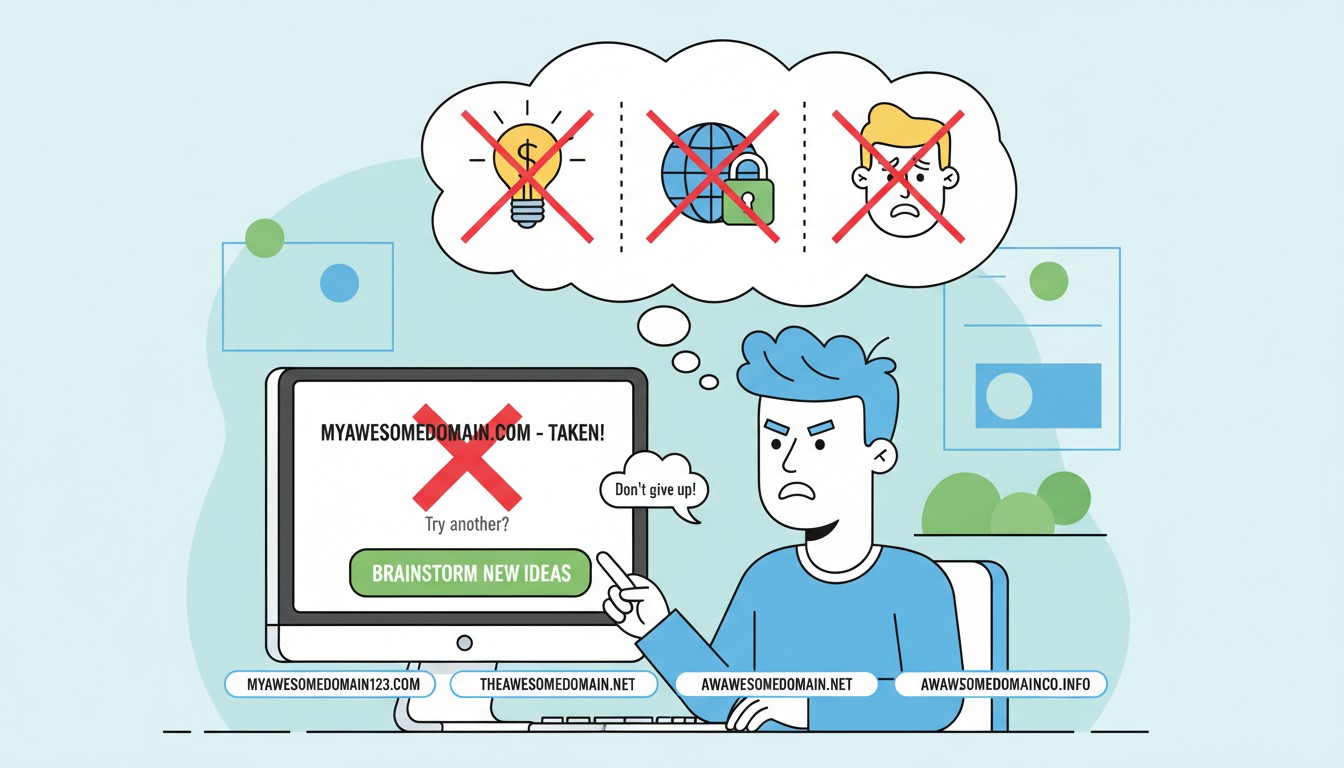
The domain name you want is almost never available. With over 1.2 billion domain names registered globally and 1.2 million new domains added daily, the internet’s real estate market is a battlefield where hesitation costs you everything. Yet founders treat domain selection as a creative exercise rather than a high-stakes negotiation with digital scarcity.
Research from Verisign’s Domain Industry Brief reveals that 57% of users automatically assume a business uses a .com domain, and 3.8x more users default to .com when guessing URLs. Meanwhile, a study by Nielsen Norman Group shows that domain name memorability drops by 34% when alternative TLDs (.io, .co, .net) are used, and brand recall plummets by 42% when domains exceed 15 characters.
The cognitive load is real and expensive. When your domain is hard to remember, you lose direct traffic, word-of-mouth referrals, and repeat customers. You become dependent on paid ads and SEO, transforming a one-time domain cost into a perpetual marketing tax.
The .com Compulsion: Why Your First Choice Is Probably a Fantasy
The .com TLD is digital gold not because it’s technologically superior, but because it’s psychologically ingrained. When you tell someone your business is “ParcelFlow,” their brain automatically appends “.com” before they even process the rest of the sentence. This is called the “default TLD heuristic”—a mental shortcut formed over three decades of internet use.
The numbers are brutal. According to Namecheap’s 2024 analysis, 94% of .com domains consisting of common English words are already registered. For two-word combinations, the figure is 87%. For single-word domains under 8 letters, it’s 99.8%. Your “perfect” domain name has likely been squatted since 2003, waiting for you to pay the ransom.
But the real cost isn’t the domain investor’s asking price—it’s the opportunity cost of emotional attachment. Founders waste weeks negotiating with squatters, refusing to consider alternatives because they’ve fallen in love with a digital mirage. Meanwhile, their competitor launches with a mediocre domain but a superior product and captures the market.
The .com vs. Alternative TLD Reality Check
57% of users automatically assume .com for any brand name
3.8x more likely to be guessed correctly than any other TLD
2-3x higher resale value than alternatives—it’s a liquid asset
Neutral SEO treatment by Google, but higher click-through rates due to trust
Not tied to geography—crucial for global businesses
The 7 Creative Escape Routes: When .com Is Dead
When your perfect .com is gone, you have seven strategic paths forward. Each has trade-offs in memorability, trust, and long-term asset value.
1. The Modifier Method: Add One Strategic Word
ParcelFlow.com → GetParcelFlow.com, ParcelFlowHQ.com, ParcelFlowApp.com
Pros: Keeps brand name intact, minimal confusion
Cons: Customers forget the modifier; you become free advertising for the .com owner
Best for: B2B services where domain is typed, not spoken
2. The Country Coder: Use ccTLD Strategically
ParcelFlow.io, ParcelFlow.co, ParcelFlow.ai
Pros: Can signal industry (.ai = AI, .io = tech), often available
Cons: .co confuses with .com; .ai/.io face 18x higher phishing flags
Best for: Tech startups with educated audiences who understand TLDs
3. The Abbreviation Game: Initialisms Work
ParcelFlowLogistics.com → PFL.com (if available)
Pros: Short, easy to type, premium feel
Cons: Requires significant education budget; no SEO benefit
Best for: Established brands with marketing muscle
4. The New gTLD Frontier: .app, .shop, .tech
ParcelFlow.shop, ParcelFlow.app, ParcelFlow.tech
Pros: Descriptive, often cheaper, trademark protection included
Cons: 94% of users don’t recognize them; email deliverability issues
Best for: Niche apps where the TLD is part of the product name
5. The Domain Hack: Creative Spelling
ParcelFlw.com, Parcelflow.io, Parcel-Flow.com
Pros: Keeps brand name, can be clever
Cons: Massive confusion; customers forget the missing letters or hyphens
Best for: Nothing. Avoid this trap at all costs
6. The Brand Pivot: Rename Entirely
ParcelFlow.com taken → FlowSend.com, ShipSwift.com
Pros: Clean .com, full trademark protection, no confusion
Cons: Requires rebranding all materials, losing name equity
Best for: Pre-launch businesses with minimal brand investment
7. The Acquisition Play: Buy Your Way Out
Pay the squatter $2,000-$50,000 for ParcelFlow.com
Pros: You get the perfect .com
Cons: Expensive, encourages squatting, can be a negotiation nightmare
Best for: Well-funded ventures where domain is mission-critical
The Domain Hack Trap: Why You Should Never Use Hyphens or Misspellings
Domain hacks like “Parcel-Flow.com” or “ParcelFlw.com” seem clever but create catastrophic customer confusion. Studies show 68% of users forget hyphens when typing, and 73% default to the correct spelling. You’re not being creative—you’re creating free advertising for the .com owner.
Every time you say “It’s ParcelFlow without the ‘o’,” you’re burning marketing dollars and training customers to go to your competitor. This is the most expensive “savings” you’ll ever achieve.
The Cognitive Science: What Makes a Domain Memorable
When your first choice is taken, you’re not just losing a domain—you’re losing cognitive advantage. The science of memorability reveals why certain domains stick and others vanish.
The 3-5-7 Rule: Length Matters More Than You Think
Studies show humans process 3-5 letter words fastest, and working memory holds 7±2 chunks. A domain like “PFL.com” is cognitively optimal. “ParcelFlow.com” is acceptable. “ParcelFlowLogistics.com” is a memory disaster.
Research from Spaceship’s domain psychology analysis confirms that domains with 2-4 syllables outperform longer domains by 34% in recall tests. When your first choice is taken, the temptation is to add words, but this is cognitive suicide.
Phonological Loops: Why Some Domains Get Stuck in Your Head
The brain’s phonological loop processes sounds temporarily. Alliteration (“BlueWave.com”), assonance (“ShipSwift.com”), and rhythm (“Zoom.com”) create audio hooks that loop in memory. When you can’t get your first choice, artificially creating these patterns in your alternative is critical.
Recognition vs. Recall: The Domain Paradox
Descriptive domains like “AustinPlumbing.com” score high on recognition (people know what you do) but low on recall (they forget the exact city). Arbitrary domains like “BlueWave.com” score low on recognition but high on recall if paired with strong branding. Dynadot’s research shows users read only 20-28% of web text, making domain recognition critical for scanning.
The Memorability Checklist for Alternative Domains
✅ Can a 5-year-old pronounce it correctly?
✅ Can someone type it after hearing it once in a loud bar?
✅ Does it create a mental image or sound pattern?
✅ Is it < 15 characters and < 4 syllables?
✅ Does it avoid numbers, hyphens, and unusual spellings?
The Legal Minefield: Trademark Conflicts and Domain Disputes
When your first choice is taken, your second choice might be legally radioactive. The nightmare scenario: you build a brand on “BlueWaveLogistics.com” only to discover BlueWave is a trademarked CRM software. You could lose your domain—and your business—in 60 days.
The UDRP Fast Track: Losing Your Domain in 60 Days
The Uniform Domain-Name Dispute-Resolution Policy (UDRP) allows trademark owners to seize domains in approximately 60 days :
1. Complaint filed
2. 20 days for your response
3. Panel appointed within 5 days
4. Decision rendered within 14 days
5. Implementation 10 days later
To lose your domain, the trademark owner must prove three things :
1. Your domain is identical/confusingly similar to their trademark
2. You have no legitimate rights to it
3. You registered in bad faith
The real-world cases are terrifying. The Leonardo DiCaprio Foundation lost LDCFoundation.org due to an admin error—someone forgot to renew it, and a cybersquatter snatched it within hours . They recovered it via WIPO complaint, but most small businesses don’t have those resources.
The Nissan Nightmare: When Your Legal Name Isn’t Enough
Uzi Nissan registered Nissan.com in 1994 for his computer business, using his legal family name. When Nissan Motor Corporation entered the U.S. market, they sued for trademark infringement. Despite Uzi’s legitimate rights and prior use, he faced an eight-year legal battle and spent hundreds of thousands in legal fees to defend his own name .
The lesson: even legitimate registration doesn’t protect you from expensive battles. Before you settle on an alternative domain, run a comprehensive trademark search. The USPTO’s TESS database is free. Use it.
Pre-Domain Registration Legal Checklist
📝 Run USPTO trademark search for exact name and similar-sounding variations
📝 Google “[Your Name] + [Your Industry]” to find unregistered but active uses
📝 Check international trademarks if you plan global expansion (WIPO database)
📝 Document your legitimate business purpose before registering
📝 Consider trademark registration simultaneously ($250-$350 via USPTO TEAS)
SEO Aftermath: The Hidden Cost of Domain Changes
If you think your SEO suffers when your first-choice domain is taken, wait until you see what happens when you change domains later. The impact is catastrophic if handled poorly.
The Domain Migration Death Spiral
When you change domains, Google sees a new website, not a moved one. Your old domain’s authority (backlinks, age, trust signals) doesn’t automatically transfer. Studies show:
• Temporary 50-70% traffic drop for 3-6 months
• Risk of pages being deindexed entirely
• Loss of referral traffic from broken links
• Reduced domain authority if redirects aren’t perfect
One case study showed a business that migrated from “OldDomain.com” to “NewDomain.com” without proper 301 redirects lost 80% of organic traffic overnight and never fully recovered, even after 12 months of remediation.
The Right Way to Migrate (When You Must)
If you must change domains, the process is surgical:
1. Set up 301 redirects from every old URL to new URL
2. Submit Change of Address in Google Search Console
3. Update all internal links to point directly to new domain
4. Maintain old domain registration for at least 1 year
5. Monitor crawl errors daily for 90 days
Even perfectly executed migrations see a 3-month traffic valley. Most small businesses can’t survive this, which is why choosing the right domain initially is critical.
The Domain Migration Survival Kit
📊 Accept a 50% traffic drop for 90 days—budget accordingly
🔗 Map every old URL to a new URL—no 404s allowed
📝 Update backlinks from high-authority sites personally
📢 Announce the change to customers via email and social
⏱️ Plan migration during your slowest business season
The 21-Day Domain Decision Framework: From Panic to Launch
When your first choice is taken, don’t panic-purchase an alternative. Run this three-week sprint to make a strategic decision:
The Domain Decision Sprint
Days 1-3 (Confirm): Verify first choice is truly taken. Check WHOIS. See if it’s parked or active. Contact owner with lowball offer if available.
Days 4-7 (Generate): Create 50 alternatives using the 7 escape routes. No judgment. Quantity over quality.
Days 8-14 (Test): Run the phone test: Say each domain to 10 people. Text them an hour later asking them to type it. Highest accuracy wins.
Days 15-18 (Legal): Run USPTO trademark search and Google conflict search. Eliminate any with red flags.
Days 19-21 (Decide): Choose the domain that balances memorability, legal safety, and TLD authority. Register it and immediately set up trademark monitoring.
The Long Game: Making Any Domain Work
Here’s the uncomfortable truth: the domain matters far less than what you do with it. “Amazon.com” meant nothing until Bezos made it mean everything. “Google.com” was a misspelled math term. “Zynga.com” was the name of the founder’s dog. The domain is a vessel; your business is the liquid.
If you’re waiting for the perfect domain to launch, you’re making an excuse. The perfect domain doesn’t exist, or it’s $50,000, or it’s taken. Launch with what you have and make it perfect through execution. A mediocre domain with a memorable brand beats a perfect domain with a forgettable business every time.
The Domain Agnostic Success Formula
1. Brand the TLD: If you use .io, make .io part of your story. “We’re ParcelFlow.io—optimized for the future of shipping.”
2. Repeat, repeat, repeat: Say your domain in every email, ad, and conversation until it becomes a memory loop
3. Buy the misspellings: If you use .co, also buy .com and redirect it
4. Make the experience unforgettable: The domain is forgettable if your service is unforgettable
The Domain Is a Door, Not the House
obsessing over the perfect domain is like refusing to open a restaurant because the front door isn’t the exact shade of red you wanted. Customers don’t remember the door. They remember the food, the service, the feeling of being cared for.
Your domain is a door. Make it functional, make it findable, but don’t let it delay your launch. The best domain is the one that’s live and building a reputation, not the one that’s perfect and parked.
Choose the best available domain today. Launch tomorrow. Make it memorable through execution, not etymology. In five years, no customer will remember what your domain was—they’ll only remember whether you solved their problem. Build the house. The door can be repainted.