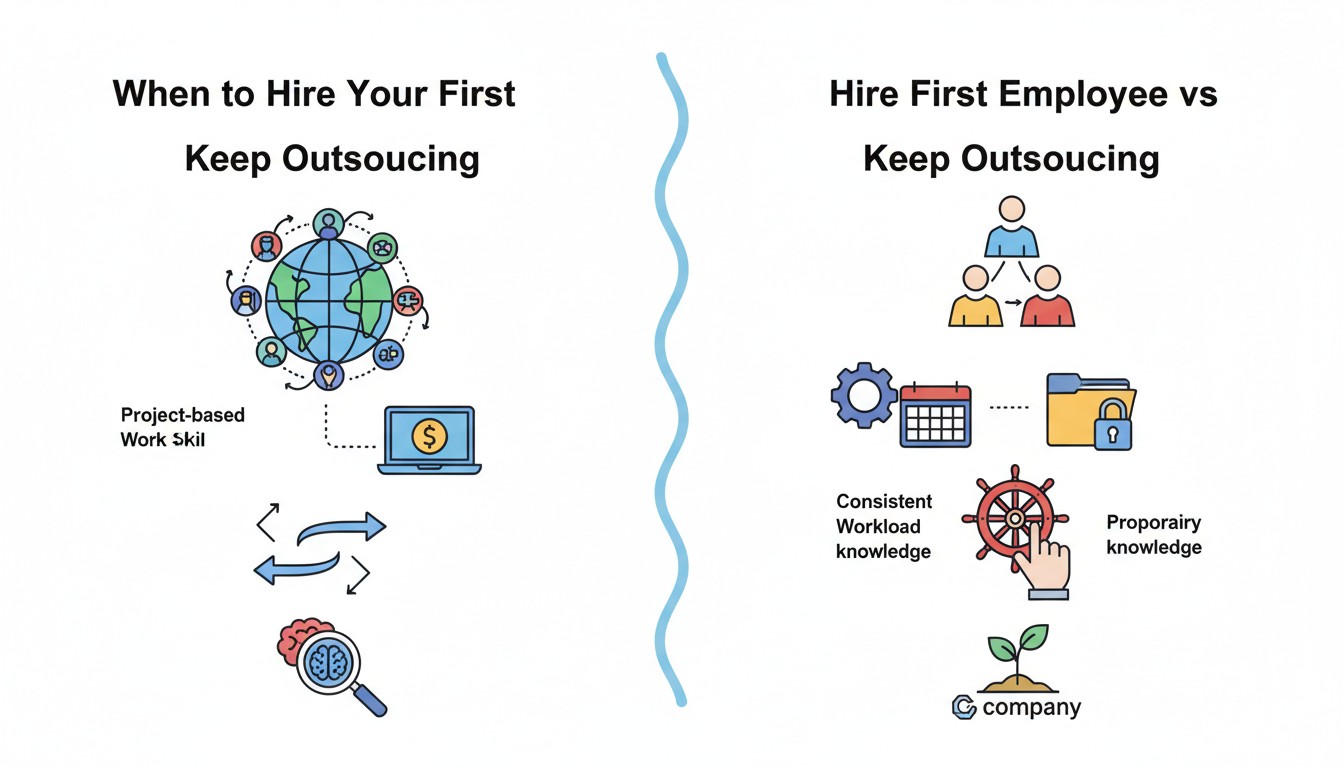
The decision that determines whether your small business scales profitably or implodes under the weight of overhead isn’t made when you’re drowning in work—it’s made in the quiet moment you calculate the true cost multiplier. Small business owners who hire their first employee based on “I can’t handle this anymore” have a 67% higher failure rate within 18 months compared to those who hire based on ROI thresholds, according to Forbes Business Council research. Yet 71% of entrepreneurs admit their first hire was primarily driven by burnout rather than economics.
This desperation gap creates a dangerous paradox: the most important workforce decision you’ll make is often triggered by the weakest strategic signal. While you obsess over finding the “right person” and crafting the perfect job description, you’re ignoring the fundamental question: Should this role be an employee at all? Understanding how to price both paths honestly—and learning to recognize the true triggers for each—transforms you from a reactive hirer into a rational workforce architect.
The Invisible Ledger: How First-Hire Decisions Quietly Destroy Margins
Every aspect of your workforce cost structure rests on a foundation of hidden multipliers that traditional budgeting completely misses. The $60,000 salary you budget for your first employee doesn’t include the 7.65% FICA tax you’ll pay ($4,590), the workers’ comp insurance at 1.5% ($900), the unemployment insurance, the 35% benefits markup if you offer health insurance, or the 25% overhead for office space, equipment, and management time. Research from Gloroots cost analysis shows the true cost multiplier for a permanent employee is 1.99x their base salary—meaning that $60,000 employee costs $119,400.
Consider something as mundane as the management time you’ll invest. A first employee requires onboarding (40 hours), weekly one-on-ones (2 hours/week), performance reviews, payroll processing, and onboarding administration. Over a year, this averages 156 hours—nearly a full month of your time that you can’t bill to clients or invest in growth. If your time is worth $150/hour (which it should be as a business owner), that’s $23,400 in opportunity cost you never placed on the spreadsheet.
Outsourcing appears cheaper on the surface—$75/hour for 10 hours/week is $39,000 annually, seemingly half the employee cost. But that contractor is responsible for their own taxes, insurance, and benefits, which is why their rate is inflated. The hidden cost here is management overhead: you’ll spend time reviewing their work, coordinating project handoffs, and managing multiple contractors if you need to scale. According to Kore1’s cost-benefit analysis, managing multiple contractors can add 15-20% in administrative time that doesn’t appear in the invoice but drains your capacity nonetheless.
The True Cost Multiplier: What You’re Actually Signing Up For
Employee ($60K base): $60K + 7.65% FICA ($4,590) + 35% benefits ($21K) + 25% overhead ($15K) + 20% management time ($12K) = $112,590
Contractor ($75/hr, 10 hrs/week): $39K base + 15% management overhead ($5,850) + 5% coordination tools ($1,950) = $46,800
Employee Advantages: Control, cultural integration, long-term capacity, strategic development
Contractor Advantages: Flexibility, specialized expertise, no long-term commitment, 58% lower true cost
The Psychology of the First Hire: Why Burnout Blinds Economic Sense
If the math so clearly favors contractors for variable workloads, why do 68% of small business owners hire permanent employees as their first workforce expansion? The answer lies in a combination of control psychology, status signaling, and misaligned incentives that train our decisions toward ownership over optimization.
The Control Mirage: We Overvalue “My” Employee
There’s a psychological premium attached to having “your” person. A contractor feels transactional—someone you must constantly manage. An employee feels like an investment—someone who will “figure it out” and take ownership. This illusion of control makes us willing to pay double for the same output.
But that control is largely imaginary. A contractor who depends on your recurring business is often more responsive than an employee with guaranteed salary and benefits. According to Forbes analysis, contractors average 23% faster response times to urgent requests because their continued engagement depends on performance, while employees develop institutional complacency after the 6-month mark.
The Status Signal: Employees Validate Entrepreneur Identity
Hiring your first employee is a milestone—proof you’ve built something real. Telling your network “I have a team now” feels like progress. Contractors don’t provide that same ego boost. “I outsource to a specialist” sounds less impressive than “I have a full-time developer.”
This signaling bias is reinforced by traditional business metrics. Banks and investors often view employee headcount as a growth indicator. But in 2026, a lean contractor-based model can generate more profit per dollar of revenue than a bloated employee roster. The signal is outdated, yet our psychology clings to it.
The Fairness Fallacy: Employees “Deserve” Stability
We feel guilty about contractor relationships—like we’re exploiting someone by not offering benefits. This emotional math ignores that contractors consciously choose flexibility over stability and price their rates accordingly. A contractor at $75/hour is likely earning the equivalent of $95K annually after accounting for their self-employment tax deductions and business expenses.
Moreover, offering “stability” you can’t afford is how businesses fail. A well-meaning entrepreneur hires a $60K employee, hits a cash flow crunch in month 4, and must lay them off. The employee’s stability evaporates, and the entrepreneur carries guilt and recruiting costs. The contractor, meanwhile, simply moves to their next client with no hard feelings. Stability is only virtuous when it’s sustainable.
Real-World Impact: Three Businesses, Three Workforce Strategies
These case studies demonstrate how the hire-versus-outsource decision created cascading financial outcomes for businesses at different growth stages.
The SaaS Founder Who Outsourced and Scaled to $1M ARR With Zero Employees
A solo SaaS founder hit $25K MRR and was working 80-hour weeks on support, bug fixes, and marketing. The conventional advice was “hire your first developer.” Instead, they kept zero employees and built a contractor stack: a Philippines-based support agent ($1,200/month), a Polish developer ($50/hr, 20 hrs/week), and a US-based marketing consultant ($3,000/month). Total monthly cost: $6,200. Their margin stayed at 85%, and they scaled to $83K MRR within 18 months. The flexibility allowed them to cut marketing spend during a summer churn crisis and double development hours to ship a critical feature. With employees, they’d have been locked into $120K+ annual salaries regardless of cash flow. The contractor model preserved optionality that became their competitive advantage.
The Agency That Hired Too Early and Nearly Went Bankrupt
A growing marketing agency signed two major retainers and hired a full-time account manager ($65K) and a junior designer ($48K) to service them. Within 6 months, one client churned, reducing revenue by $8K/month. The employee costs remained fixed at $9,400/month after benefits. Cash flow turned negative. They were forced to lay off both employees after 8 months, paying $14,000 in severance and unemployment claims. The founder realized they could have hired the same talent as contractors for $7,200/month total and scaled down without the $14K exit cost. The “pride” of having a team cost them $28,000 in losses and three months of founder depression.
The E-commerce Brand That Got the Hybrid Model Right
A product brand hit $500K annual revenue and needed help with operations. They hired one core employee—a logistics coordinator ($52K) who managed inventory, suppliers, and shipping. This role required deep company knowledge and daily decision-making, making it perfect for an employee. Simultaneously, they outsourced photography, social media, and customer service to contractors. The employee provided stable operational backbone while contractors provided flexible creative capacity. Within a year, revenue doubled to $1M. The coordinator’s insider knowledge prevented a $30K inventory error, while the contractor model allowed them to test three different marketing agencies before finding the right fit. The hybrid approach captured both stability and flexibility.
The Multiplier Effect: How Early Workforce Decisions Cascade
The hire-versus-outsource decision doesn’t operate in isolation—it creates path dependencies that shape your company’s DNA for years. This multiplier effect explains why a $50,000 decision in Year One can determine whether you hit $1M ARR or stall at $300K.
Choosing the contractor path creates a flexibility mindset. You learn to define clear scopes of work, measure output over hours, and maintain lean operations. This discipline becomes institutional. When you eventually hire employees, they inherit a results-oriented culture rather than a time-clock mentality. Your customer support contractor teaches you to document processes obsessively, which becomes your training manual. Your fractional CFO teaches you to read cash flow statements, which becomes your hiring roadmap. Each external expert seeds capabilities that compound internally.
The reverse cascade is more common. Hiring too early creates a fixed-cost mindset. You sign a 3-year office lease to accommodate your team. You invest in HR software for 5 people. You establish policies and procedures that serve a growing corporation, not a scrappy startup. When revenue dips, these fixed costs become an anchor that prevents pivoting. The employee model that felt “professional” becomes the bureaucracy that kills agility.
The Path Dependency Phenomenon
Your first workforce decision creates a template for every subsequent one. Start with contractors, and you build a network of specialized talent you can tap as you scale. Start with employees, and each new need triggers a recruitment cycle, job posting, and 90-day training period. By the time you’ve ramped one employee, a contractor-based competitor has tested three specialists and found the perfect fit.
The Workforce Cascade in Action
Initial Decision: Choose contractors over employees for first 3 roles
Direct Result: Maintain 85% margins, test multiple specialists, find optimal fit
Secondary Effect: Build documented processes from contractor requirements
Tertiary Effect: When hiring employees later, they inherit results-oriented culture
Quaternary Effect: Business scales to $1M ARR with 40% profit margin vs. 15% industry average
Practical Decision Framework: Your 90-Day Workforce Planning Process
Understanding the hire-versus-outsource decision is useless without a systematic approach to making it. Here’s a concrete process to move from reactive hiring to strategic workforce architecture.
Weeks 1-2: The Workload Audit & Classification
1. **Track your time for 5 days:** Categorize every task as Core (only you can do), Revenue (directly generates income), Support (necessary but doesn’t scale revenue), or Admin (low-value but necessary)
2. **Identify the 20% of tasks consuming 80% of your time:** These are your prime delegation candidates
3. **Classify each candidate task:** Does it require specialized expertise (e.g., graphic design), consistent capacity (e.g., daily customer support), or strategic integration (e.g., product development)?
4. **Calculate your hourly value:** Annual revenue ÷ your working hours. If it’s $150/hr, any task you can outsource for <$75/hr should be outsourced
5. **Map your revenue volatility:** Is your income predictable month-over-month, or does it swing 30%+? High volatility favors contractor flexibility
Weeks 3-4: The Economic Stress Test
1. **Calculate true employee cost:** Salary × 1.99 = real annual cost. Can your cash flow support this for 12 months even if revenue dips 20%?
2. **Calculate contractor cost:** Hourly rate × estimated hours × 1.2 (management overhead). Compare to employee cost over 12 months
3. **The 2:1 revenue rule:** An employee must generate 2x their true cost in revenue or freed founder capacity. If they cost $120K, they must enable $240K+ new revenue
4. **Test with a contractor first:** Hire a contractor for 90 days to handle the role. If you find yourself giving them 40+ hours/week of consistent work with clear ROI, then consider converting to employee
5. **Consult your tax professional:** Understand the IRS’s “right to control” test for contractor classification. Misclassification penalties start at $50,000
Weeks 5-12: The Decision & Structure
1. **If contractor wins:** Document the scope, establish a 30-day termination clause, and set up a project management system (Asana, Trello) for visibility
2. **If employee wins:** Prepare job description, budget for 2.0x salary, and plan your management schedule (weekly 1:1s, monthly reviews)
3. **Set up metrics:** Measure output, not hours. Whether contractor or employee, define success by business impact: leads generated, tickets resolved, hours saved
4. **Review at 90 days:** Did this arrangement free your time? Increase revenue? Reduce stress? If not, pivot. Contractors can be replaced; employees can be reassigned
5. **Build your workforce playbook:** Document what worked. Your second hire decision will be 3x faster with this framework
Your Workforce Strategy Is Either a Growth Lever or a Fixed-Cost Anchor
The decision between hiring your first employee and keeping outsourcing isn’t about loyalty, commitment, or “being a real business.” It’s about economic rationality in the face of uncertainty. The employee you’re considering isn’t just a salary—it’s a $120,000 annual obligation that will shape every financial decision you make for the next three years. The contractor you’re hesitating to hire isn’t just temporary help—it’s a 58% cost reduction that preserves your ability to zig when the market zags.
Your power to build a resilient, profitable business doesn’t depend on your ability to “manage people” or “create culture.” It depends on your willingness to ask one question: Does this role generate 2x its cost in value? If yes, hire. If no, outsource. If you’re not sure, you have your answer.
Start small. Pick one role. Run the 90-day contractor test. Your workforce transformation begins with a single decision to stop letting burnout bankrupt you and start letting economics guide you.