A business name is not a label—it’s a memory device. It’s the difference between a customer finding you again or forgetting you exist. Research from the Nielsen Neuroscience Brand Memory Study reveals that memorable names drive 34% higher brand recall and 23% greater purchase intent. Yet founders treat naming as a creative writing exercise instead of a strategic engineering problem. They obsess over domain availability and trademark clearance but ignore the psychological principles that make names stick in human brains.
The graveyard of forgotten businesses is filled with clever names. “Zyzzyx,” “Qriosity,” “Xuberal.” Names that looked cool in a logo but failed the ultimate test: can a tired customer recall it at 11 PM after hearing it once in a podcast ad? The founder of Baremetrics learned this when they discovered “Metor” (their original name) was misheard as “Metro” in 40% of customer interviews. They renamed to a word that combined “bare” (transparent) + “metrics” (data). Memorability increased overnight because the name was a simple phrase customers already understood.
The Cognitive Science: Why Some Names Stick and Others Vanish
Human memory isn’t a filing cabinet—it’s a pattern recognition machine. Your brain encodes information through three pathways: phonological (how it sounds), semantic (what it means), and emotional (how it feels). A memorable name must score high on all three. This is why “Apple” works despite having nothing to do with computers: it’s phonologically simple (two syllables), semantically familiar (everyone knows an apple), and emotionally positive (healthy, natural).
The most critical factor is cognitive load. Research from Harvard’s Memory Lab demonstrates that working memory can only hold 7±2 “chunks” of information. A name like “Quantummm Solutions” consumes multiple chunks (the word, the spelling, the three M’s). A name like “Mop & Glow” is one chunk: a simple phrase with built-in imagery. This is why compound names often outperform invented ones.
The Three Pillars of Memorability
1. Phonological Simplicity
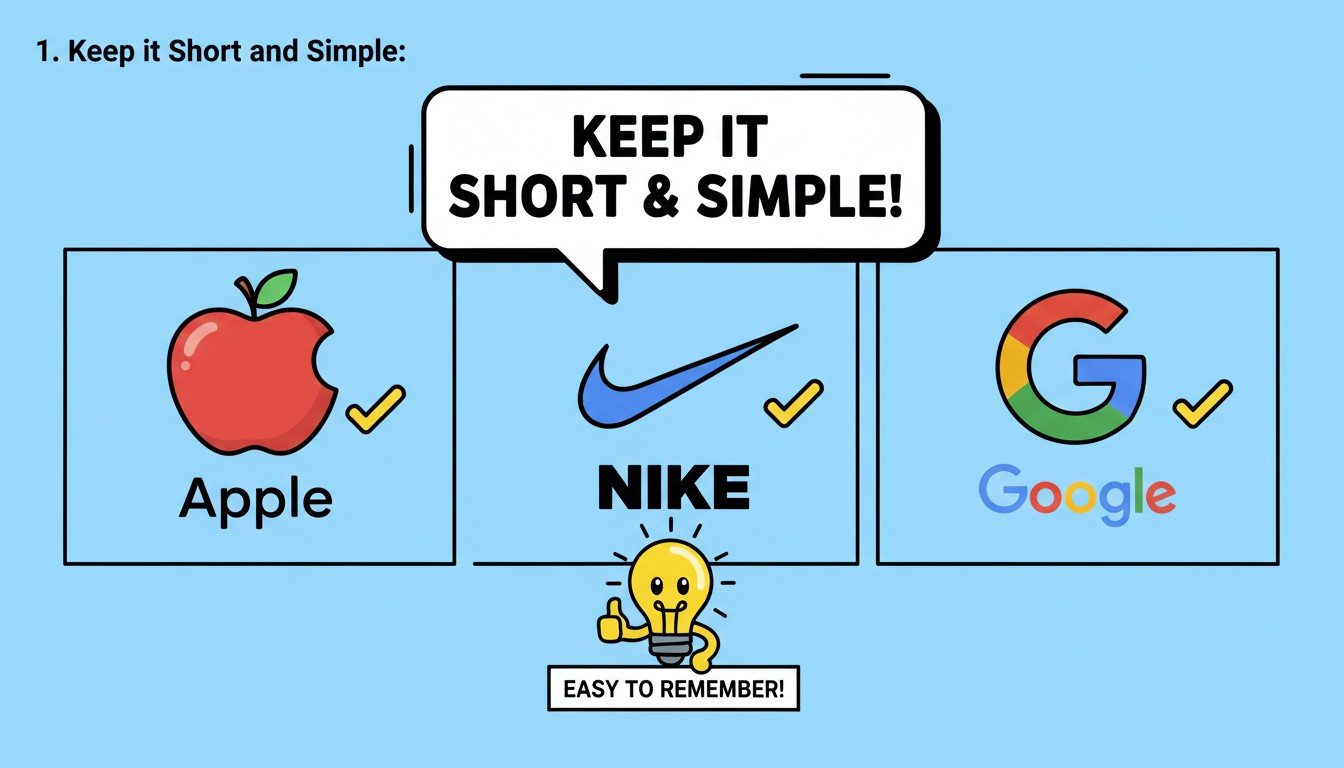
Names with 2-4 syllables and simple consonant-vowel patterns are easiest to remember. “Google” (2 syllables), “Nike” (1), “Slack” (1). Avoid clusters like “Xybrium.”
Test: Can a 5-year-old pronounce it?
2. Semantic Resonance
The name should connect to existing mental concepts. “Stripe” = payment lines. “Zoom” = fast movement. Avoid abstract sounds like “Zynga.”
Test: Does it evoke a mental image?
3. Emotional Trigger
The amygdala encodes emotional memories. “Triumph Motorcycles” triggers victory. “Warby Parker” sounds playful and rebellious.
Test: Does it make you feel something?
The Seven Deadly Sins of Business Naming
Before you can create a memorable name, you must avoid the mistakes that make names forgettable. These aren’t just bad practices—they’re cognitive landmines that sabotage recall before you even launch.
The Forgettable Name Hall of Shame
| Sin | Why It Fails | Real Example | Better Alternative |
|---|---|---|---|
| The Spelling Disaster | Forces customers to ask “how do you spell that?” | “Xceler8 Solutions” | “QuickFleet” |
| The Me-Too Name | Sounds like every competitor. “TechPro,” “DataSys” | “Innovative Analytics” | “NumberFlow” |
| The Abstract Nonsense | No mental anchor. “Zyngl,” “Qriosity” | “Zyngl” | “QuizCraft” |
| The Overloaded Name | Tries to explain everything. “Smith Family Landscaping & Home Improvement” | “Smith Family Landscaping & Home Improvement” | “GreenSprout” |
| The Fad Name | Tied to a trend that will date. “NFT_Studio,” “Metaverse Pro” | “Metaverse Marketing Co.” | “Virtual Reach” |
Memorability Frameworks: Four Proven Naming Techniques
Now that we’ve covered what to avoid, let’s engineer memorability. These four frameworks are rooted in cognitive science and have created billion-dollar brands.
1. The Compound Connector
Combine two simple words that each evoke imagery. Facebook, Snapchat, Mailchimp. The magic is that each word is already a memory chunk. Your brain doesn’t create new storage; it links existing files.
How to create: List 20 words related to your industry (mail, ship, craft). List 20 words with emotional power (chimp, monkey, rocket). Mix and match until you find a pair that paints a picture.
2. The Metaphor Maker
Name your business after something that behaves like your product. Amazon (big river = big selection), Trello (trellis = growth structure), Stripe (stripe = payment line). The metaphor creates instant understanding.
How to create: Ask “What object in nature/man-made world behaves like my product?” Is it a bridge? A filter? A compass? Use that word.
3. The Phonetic Hook
Use alliteration, rhyme, or rhythm. PayPal, Best Buy, Coca-Cola. These names are pleasurable to say, which makes them pleasurable to remember. The brain encodes pleasure more deeply than information.
How to create: Find your core concept word. Find words that start with the same letter or rhyme. “Fund” becomes “FundFrog” or “FundFlow.”
4. The Story Kernel
Choose a name that begs for explanation. Warby Parker (two characters from a Jack Kerouac journal), Haagen-Dazs (made-up Danish-sounding name), Zappos (from “zapatos,” Spanish for shoes). The story becomes a memory anchor.
How to create: Find a story from your life, a book, or history that represents your mission. Extract a name fragment. Test if it sounds intriguing enough to make people ask “Where’d that name come from?”
Framework Application Workshop
Let’s name a fictional AI note-taking app:
Compound: Note + Bot = NoteBot (simple, but generic)
Metaphor: “Second Brain” (evokes memory, but too long)
Phonetic: MemoMatic (alliteration, sounds automated)
Story: “Kafka” (author of Metamorphosis, wrote about memory)
Winner: MemoMatic—it’s 4 syllables, phonetically pleasing, and explains itself.
Now try this for your business. Generate 5 names using each framework, then pick the one that scores highest on the memorability test.
The Legal Moat: Trademarking Your Memorable Name
A memorable name is worthless if you can’t own it. The trademark process is where many founders discover their perfect name is unusable. Before you fall in love, run these checks:
The Three-Layer Validation
Layer 1: The Google Test
Search your exact name. If page one is filled with established brands, move on. You’ll never out-SEO them. Also search “[Your Name] + [Your Industry].” If any competitor appears, you’re inviting confusion.
Layer 2: The USPTO Database
Use the USPTO Trademark Electronic Search System (free). Search exact matches and similar-sounding names. If you find a “live” trademark in your category, abandon the name. Fighting a trademark dispute costs $50K+.
Layer 3: The Domain Reality Check
A .com is still king. If it’s taken, the owner will likely ask $5K-$50K. Before you settle for .io or .co, consider if your customers will remember the odd extension. Test: tell a friend the name and see if they type .com automatically.
The Trademark Timeline
Week 1: Run Google and USPTO searches
Week 2: File trademark application ($250-$350 per class via USPTO TEAS)
Months 3-8: USPTO examination period (you can use ™ meanwhile)
Month 9: If approved, publish for opposition (30-day window)
Month 12: Registration complete. You can now use ®
The 21-Day Naming Sprint: From Brainstorm to Decision
Don’t treat naming as a weekend project. It’s a three-week sprint that moves from divergence (many ideas) to convergence (one winner). Each phase has a specific goal and deadline.
The Naming Sprint Timeline
Days 1-3 (Brainstorm): Generate 100 names. Use all four frameworks. No judgment. Quantity over quality.
Days 4-7 (Filter): Apply the seven deadly sins test. Eliminate anything with: bad spelling, taken domains, trademark conflicts. Cut to 10 names.
Days 8-14 (Test): Run the “phone test”: Call 10 friends, say each name once, hang up. Text them an hour later: “What was the name?” The name recalled by 7+ wins. If none do, restart.
Days 15-18 (Validate): Create a landing page with top 3 names using Carrd. Run $50 in Facebook ads to your target audience. Measure click-through rate. Highest CTR wins.
Days 19-21 (Register): File trademark, buy domain, secure social handles. Announce it to your waitlist.
The Final Word: A Name Is a Promise
A memorable name isn’t clever—it’s trustworthy. It’s a promise that your business will be as easy to work with as your name is to say. “Stripe” promises simple payment lines. “Zoom” promises fast video. “Mailchimp” promises friendly email marketing. The name is the first delivery on your brand promise.
The founders who obsess over names for months aren’t wasting time—they’re building a memory asset that pays dividends for decades. Your name is spoken in every sales call, typed in every Google search, remembered in every water-cooler recommendation. A name that costs $0 to create but saves $50K in marketing spend is the highest ROI decision you’ll make.
Stop searching for the perfect name and start testing the memorable one. The market doesn’t reward creativity—it rewards recall. Your customers shouldn’t have to work to remember you. Make it easy. Make it obvious. Make it stick.
Your Name Is Your Customer’s Memory Burden
Every business name asks customers to do work: remember it, spell it, pronounce it, recommend it. Most names ask too much. They require mental heavy lifting that customers simply won’t do.
The memorable name is a gift. It’s short, it’s simple, it triggers an image and a feeling. It slides into conversation naturally. It types itself into Google. It sticks after one hearing.
Your next move isn’t to brainstorm clever puns or invent words. It’s to find the simplest possible combination of familiar concepts that explains what you do. Then test it. Then own it. The best name isn’t the one you love—it’s the one your customers can’t forget.